Last updated 2026-08-19
TL;DR
Porta potty rental is a route trade. You place portable toilets, service them on a schedule, and haul domestic septage to a legal plant or permitted site. Start with an entity, an EIN, insurance a dump site will accept, then the state hauler credential your board actually issues. OSHA 1926.51 sets construction toilet counts. A CDL applies once the truck GVWR hits 26,001 pounds. Confirm fees with your board. No federal license exists.
What is porta potty rental?
Porta potty rental is a route business. You place portable toilets, service the tanks and supplies on a cycle, and haul the waste to a legal disposal point. You invoice for delivery, a standing service day, then pickup. The plastic cabinet is inventory. The route is the company.
Weekday demand sits on construction. General contractors need toilets that meet job-site sanitation rules, and they need a service day they can predict. Weekends pull from sports, festivals, and private events. Storm work is real, but it comes in bursts. You cannot plan a first-year truck note around disaster calls.
The waste in the tank already has a federal name. EPA 40 CFR 503.9 classifies material pumped from a portable toilet as domestic septage. The rule text is blunt: "Domestic septage is either liquid or solid material removed from a septic tank, cesspool, portable toilet, Type III marine sanitation device, or similar treatment works that receives only domestic sewage." [3]
That one sentence is why plants and state hauler boards treat you like a septage operator, not a party-rental shop. If you keep one legal fact, keep that one.
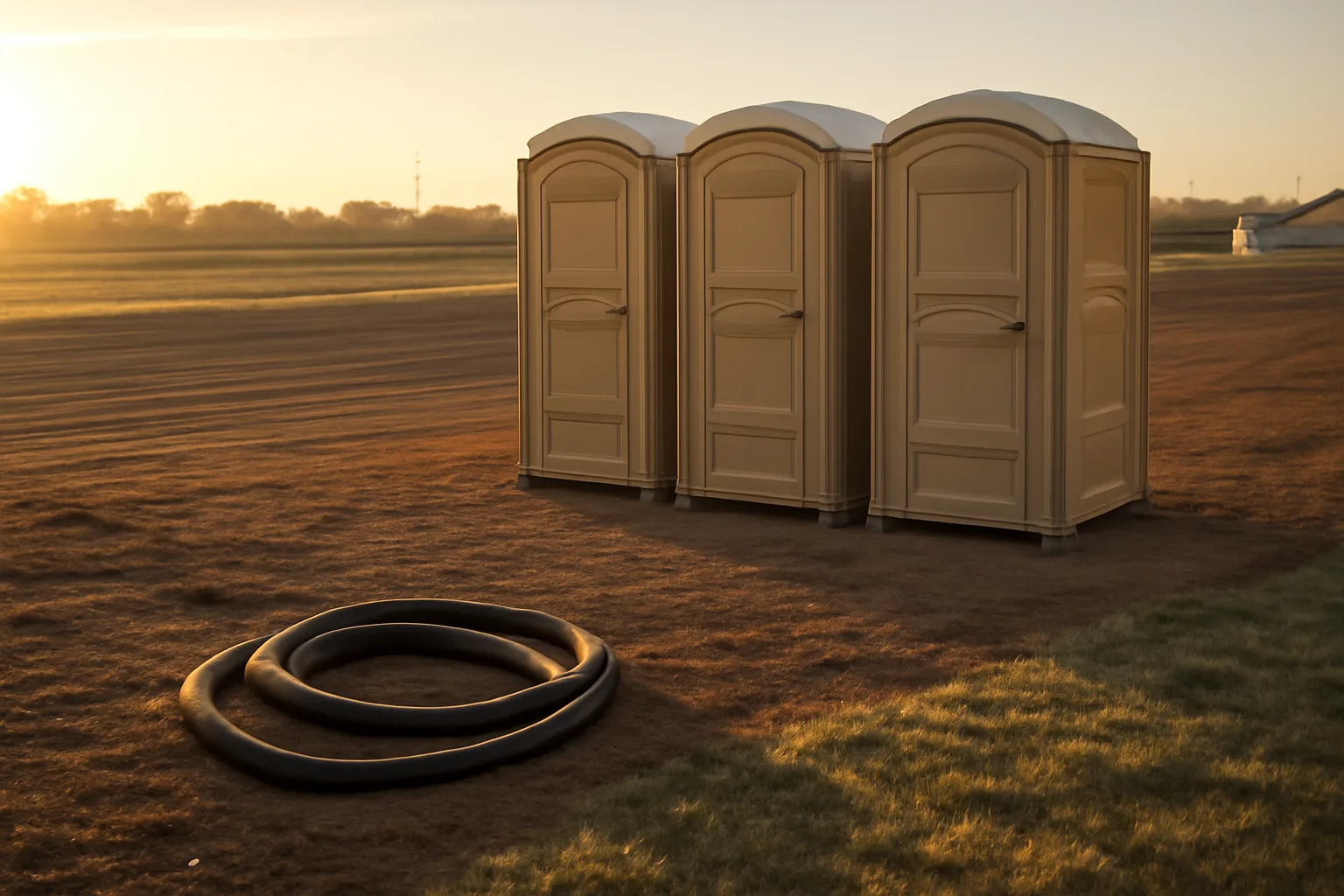
A standard unit is a molded polyethylene cabinet with a waste tank, a seat, a urinal, a vent, and a door latch. You add paper, a deodorizer, and sometimes sanitizer. Hand-wash stations are separate gear. Luxury trailers are a different capital stack. I would not buy a trailer in year one.
People also say portable sanitation or construction toilets. Same trade. Customers type porta potty rental. Use their words on the invoice and keep the legal name of the waste on the dump ticket.
How do you start porta potty rental?
You start on paper, not on a random lot of used cabinets. Form an entity, get an EIN from IRS, open a bank account that is not your personal checking, and call the state or county board that licenses septage or waste transporters. Ask that board which credential covers portable toilet waste. Confirm the current application, fee, and any vehicle decal rules with them. I will not invent a fee or a wait time. Those change and they are local. [7][8]
Then buy the insurance a dump site and a general contractor will accept. That usually means general liability, auto (including hired and non-owned if you borrow a truck), and often pollution or transporters coverage for the load. Workers' compensation shows up in most states once you have employees. Ask the plant and two local GCs for their vendor minimums before you bind a policy. Buy to those limits.
Only after a disposal agreement is real should you buy a truck and units. A restroom truck is a tank truck with a vacuum pump, wash-down water, and a way to move cabinets. If the truck GVWR is 26,001 pounds or more, FMCSA requires a CDL to operate that commercial motor vehicle. [6] Read the door sticker. Do not trust a sales story.
SBA's 10-step start guide is a decent skeleton for structure, tax IDs, and registration. [8] It will not tell you where to dump. No dump ticket, no route.
You also need OSHA counts on day one, because that is how construction buyers size an order. The chart below is the federal construction table. Learn it before you quote a 40-person framing crew.
If you want the paper path in one stack, RestroomRoute publishes a $199 one-time Portable Restroom Launch Kit at /start. This article works without it. Use the kit if you want checklists, not because a license depends on it.
How many porta potties does OSHA require on a job site?
OSHA 29 CFR 1926.51 requires 1 toilet facility for 20 or fewer construction employees, then 1 more for each 20 workers up through 100, then 1 more for each additional 20 after that. [1] That is the table your GC already knows. Quote it back to them.
The regulation says toilets "shall be provided for employees according to the following table." [1] Each water closet also needs its own compartment with a door and walls high enough for privacy. A row of open risers does not count.
For 21 to 40 employees you need 2 facilities. For 41 to 60 you need 3. Keep climbing by twenties. A job that claims 85 people at peak is 5 units under the table. Peak headcount is the number. Average Tuesday is not.
General industry uses a different table in 29 CFR 1910.141. [2] It runs tighter at the low end (one water closet per 15 employees in the first band). Most porta potty rental work is construction or events, so you will live in 1926.51. Know 1910.141 exists so you do not argue with a plant safety manager who is quoting it.
California is stricter when both sexes are on site. Cal/OSHA Title 8 section 1526 requires a minimum of one separate toilet facility for each 20 employees or fraction thereof of each sex, with a narrow exception when there are fewer than five employees and the facility can lock. [11] If you price porta potty rental cost in california work, read 1526 before you copy a national rule of thumb.
| Rule set | Source | How toilets are counted |
|---|---|---|
| Federal construction | 29 CFR 1926.51 | 1 facility per 20 employees (see table) |
| Federal general industry | 29 CFR 1910.141 | 1 water closet per 15 in the first band |
| California construction | 8 CCR 1526 | 1 per 20 employees of each sex |
Events are not OSHA construction. Ask the local event permit desk how they size public gatherings. Do not pretend 1926.51 is a concert code.
On muddy or high-abuse sites I service to the table plus one spare. The spare is cheaper than an emergency Saturday run.
What licenses do you need to haul the waste?
You need whatever septage, waste transporter, or portable toilet hauler credential your state (and sometimes your county) issues. There is no U.S. porta potty license. EPA sets how domestic septage may be used or disposed. States run the truck decals, driver cards, and manifests. Confirm the exact permit name with the environmental or health board where the waste is pumped and where it is dumped. Those can be two different offices if you cross a line.
40 CFR Part 503 is the federal biosolids and septage rule. EPA's plain-English guide to Part 503 walks through who the rule covers and why domestic septage sits inside it. [14] For land application of domestic septage, 503.15 sets pathogen and vector attraction options, including lime stabilization and injection or incorporation. [4] Most new operators never land-apply. They pay a wastewater plant or a permitted septage facility. That is the right call in year one. Land application is a farm and lab business bolted onto a route business.
Your dump site will ask for identity, a vehicle list, and sometimes a special residual-waste approval. Plants can refuse you. Get the acceptance letter in writing before you buy a yard full of units.
Hire anyone and you also pick up the ordinary employer stack and overtime rules under the Fair Labor Standards Act. DOL Fact Sheet 23 states that unless exempt, employees covered by the FLSA must receive overtime pay for hours over 40 in a workweek at a rate not less than time and one-half. [12] Route techs who run long summer days are not exempt because the truck is dirty.
Keep a binder in the cab: permit, insurance, dump letter, SDS for the deodorizer, spill plan. Inspectors ask for paper.
Do you need a CDL for a restroom truck?
You need a CDL if you operate a commercial motor vehicle that meets FMCSA's thresholds, including a vehicle with a GVWR of 26,001 pounds or more. [6] You also need one for combination vehicles that meet the GCWR test, and for placarded hazmat, which a normal domestic septage load is not. Read FMCSA's CDL page, then your state's CDL manual. States can be stricter.
Look at the manufacturer's GVWR sticker on the door jamb. That number, not the empty weight, is what matters. A used vacuum truck that "drives like a pickup" can still be a 33,000-pound GVWR truck. If it is, budget for a CDL driver and a medical certificate. Confirm current medical-card rules with your state driver license agency. Do not treat a publisher as the DMV.
Many first trucks are light chassis with a small tank and a GVWR under 26,001. That path lets you drive on a regular license in a lot of states. Confirm it for yours. Trailers change the math. A one-ton pulling a loaded restroom trailer can cross into combination CMV territory. Add the weights before you say yes to a 10-unit trailer.
Move units on a flatbed and let a separate pumper meet you on site, and you have split the CDL problem. You have also split the profit. I would rather spec the truck correctly once.
What counts as legal disposal for portable toilet waste?
Legal disposal is a facility or land-application site allowed to take domestic septage, plus the paperwork that site requires. Wastewater plants, permitted septage receiving stations, and (in some states) licensed land appliers are the usual doors. A ditch, a manhole, a storm drain, or a friend's empty field is not a workaround.
Because EPA defines portable toilet pump-out as domestic septage, a plant that takes septage can often take you, provided its local permit allows the extra load and the chemistry. [3][14] Some plants ban formaldehyde-heavy deodorizers. Ask what they refuse before you buy a tote of cheap blue liquid. Switch products if they tell you to.
Land-apply and 40 CFR 503.15 becomes your federal floor for domestic septage on agricultural land, forest, or a reclamation site. [4] Your state may add site restrictions, pH logs, and crop controls. I would not start there. One bad field complaint can eat a year of route profit.
Keep every dump ticket. Date, gallons, truck ID, facility name. GCs rarely ask. An inspector can.
Crossing a state line with a full tank can mean credentials in both states. Confirm with both boards. Do not assume reciprocity.
Disposal tip fees wreck cheap quotes. For market context on what customers pay, read porta potty rental cost in florida and porta potty rental cost in arizona.
Do portable toilets have to be ADA accessible?
On most public and commercial sites, clustered portable toilets have to include accessible units. The 2010 ADA Standards, section 213.2 Exception 3, say: "Where multiple single user portable toilet or bathing units are clustered at a single location, at least 5 percent, but no fewer than one, of the toilet units and bathing units at each cluster shall comply with 603." [5]
Do the math. A cluster of 10 needs at least one accessible unit, because 5 percent of 10 is half a cabinet and the floor rounds to one. A cluster of 40 needs two. Cluster means the pile at one location, not your whole yard.
The same section carries a construction-only exception for portable units used exclusively by construction personnel. [5] Salespeople stretch that exception. If the public, visitors, or non-construction staff can use the toilets, do not hide behind it.
Accessible units are wider, with grab bars and a different turn radius. They cost more and they eat trailer space. Stock them anyway. Event clients will ask. City parks will ask. You look like an amateur if you only own standard cabinets.
Confirm local amendments. Some event permits write a stricter accessible-unit rule than the 5 percent floor.
What equipment should you buy first?
Buy dump rights, then a legal truck, then a small mixed set of units. I would start with a vacuum truck I can legally drive, 15 to 30 standard cabinets (used is fine if the doors latch and the tanks are not cracked), 2 or 3 accessible units, and 2 hand-wash stations. That mix covers a few small construction accounts and a Saturday soccer tournament. It does not cover a 5,000-person festival. Good.
New standard cabinets sell in a wide band that moves with resin and freight. I will not print a fake national sticker price. Call two manufacturers and one used broker in the same week. Get freight to your yard in the quote. Freight is the number first-timers forget.
Skip restroom trailers until a customer has paid a deposit that covers the note. Skip wraps on every unit. Skip a second truck. Skip a long yard lease. Park on cheap fenced land you can walk away from.
Chemicals, paper, gloves, a spare pump, and a spill kit are operations, not decorations. OSHA's hazard communication standard (29 CFR 1910.1200) applies to the concentrates you pour. [13] Keep SDS sheets. Train whoever pours.
A pressure washer that actually runs will save more accounts than a new website.
For what customers pay in other markets, use porta potty rental cost in georgia and porta potty rental cost in colorado.
What does a first-year operations week look like?
A normal week is route days, one shop day, and a weekend event if you took the work. Construction gets a standing service day. You pump, refill deodorizer, restock paper, wipe touch points, and dig out any unit a forklift buried. You log gallons. You dump before the tank sloshes on the highway.
Hot weeks need more frequency. A July unit on a 40-person crew will smell like a closed dumpster if you touch it every 10 days. OSHA cares that the toilet exists and stays maintained. [1] Your customer cares that nobody gags. Meet the second standard.
CDC hand-hygiene guidance is simple, and you should make your own techs follow it: wash with soap and water for at least 20 seconds. [10] Hand-wash stations only help if you refill water and soap. An empty station is a prop.
BLS groups a lot of this fieldwork with septic tank servicers and sewer pipe cleaners. The Occupational Outlook Handbook posts the median wage on that page and updates it when new OEWS data lands. Recent handbook editions have put the median in the mid-$40,000s a year. Check the live table before you set pay. [9] Festival weeks add overtime. Budget like it.
Monday is for the calls you got Sunday night. A unit tipped. A lock failed. Build slack or you will live in that panic.
Do not take every Saturday in month two. A thin crew plus 14 event drops is how paying construction tanks go unpumped.
What paperwork do customers and inspectors ask for?
General contractors ask for a certificate of insurance with the GC and owner listed as additional insured, plus endorsement copies if their vendor packet is picky. They ask for a W-9. They sometimes want a written service schedule tied to headcount. Have those as PDFs. Do not make a superintendent wait in a trailer.
Event producers ask for a COI, sometimes a city business tax receipt, and a site plan that shows the accessible units. Parks departments ask for proof you can dump legally. A verbal "I know a guy at the plant" is not proof.
Inspectors ask for the hauler permit, the truck decal if your state uses one, and dump tickets. OSHA on a construction site is usually checking whether the toilets exist in the right number and are not vile. [1][11] They can still ask who services them.
Have employees and you also keep time records and a pay practice that survives a wage claim. Overtime after 40 hours is the default under the FLSA unless a real exemption fits. [12] Route work rarely fits the exemptions people invent at the kitchen table.
None of this article is legal advice. Confirm forms with the board that licenses you and with your insurance agent.
How should you price porta potty rental in year one?
Price from your dump fee, drive time, service frequency, and how hard the site is to reach, not from a number you saw on a national blog. Nobody publishes a clean national rate card that a board will stand behind. Local tip fees and fuel do more damage to your margin than the cabinet cost ever will.
A weekly construction unit on an easy lot is your bread route. Twice-weekly service in July is not the same product. Charge for the extra pump. Weekend event drops pay more because they wreck your Saturday and they include a short-notice pickup. Client wants an accessible unit or a hand-wash station, price the extra piece. Do not throw it in to "win" a job you will resent.
I would rather lose a race-to-the-bottom bid than own 80 units sitting at $10 a week after dump and diesel. Cheap accounts clog the route and they call the most.
State pages on this site are for local context, not a promise. Start with porta potty rental cost in alabama, porta potty rental cost in connecticut, and porta potty rental cost in idaho, then call two plants and two GCs in your own county. Your number lives there.
How do state rules differ, and what should you skip?
State rules differ in the name of the permit, whether the county also licenses you, whether portable toilet waste is called septage or residual waste, and whether the city with your yard wants its own business license. Alabama is not Connecticut. Idaho is not Florida. Read the board that can park your truck.
Some states want vehicle inspections. Some want driver training cards. Some want bonding. Confirm the current list. I will not guess a fee, a quota, or an approval date. Those are board facts. Call them.
Here is what I would skip in year one: restroom trailers, national franchise pitches, a huge new fleet financed on optimistic wedding demand, and any software that costs more than your toilet paper. A spreadsheet and a paper route sheet work until they do not. Buy software when you cannot remember which unit is at which lot.
Skip giant industrial outages too, until you have a backup pump plan. One broken PTO on the only truck and you are renting a tanker at panic rates.
Do the unglamorous work. Stand at the plant office until they tell you exactly how they want you to check in. Walk one construction site with a superintendent and ask where the forklift will not crush a unit. That hour is worth more than a logo.
Want a single stack of launch checklists, the kit is at /start. RestroomRoute is an independent publisher, not a law firm and not a service company. Use public statutes and your board. Do not treat a publisher as your regulator.
Frequently asked questions
What is porta potty rental?
Porta potty rental is a route service. You deliver portable toilets, keep them usable on a service cycle, then haul the tank contents to a legal disposal point. Customers pay for placement, service frequency, and pickup. EPA treats the pump-out as domestic septage under 40 CFR 503.9, which is why plants and state hauler boards regulate you like a septage operator.
How do you start porta potty rental?
Form an entity, get an IRS EIN, and call the state or county board that licenses septage or waste transporters. Bind insurance a dump site will accept, then secure a written disposal agreement before you buy a truck and units. Confirm every current fee and form with that board. There is no federal porta potty license. SBA's 10-step guide covers the generic startup skeleton only.
Do I need a contractor license to rent portable toilets?
Usually no, because you are hauling waste and renting equipment, not building the structure. Some cities still want a local business license for the yard. Some GCs will only vendor you if you carry specific insurance limits. Confirm with your city clerk and the environmental board that issues the hauler credential. Do not assume a contractor board is the right window.
How often should you service a rented porta potty?
Weekly is common on small, cool-weather construction jobs. Hot weather, high headcount, and heavy weekend use need more pumps. OSHA requires toilets to be provided and maintained. Your customer notices odor first. I would rather quote twice-weekly in July than win a weekly bid and get fired in week three. Events often need a mid-event service if they run all day.
Can I dump portable toilet waste at any wastewater plant?
No. The plant must be allowed to take domestic septage, and it can refuse your chemistry or your truck. Get a written acceptance letter before you buy a fleet. Keep dump tickets with date, gallons, truck ID, and facility name. A manhole, ditch, or private field is not a legal option. Confirm current receiving rules with that plant, not with a national article.
How many porta potties do you need for 50 construction workers?
Under OSHA 29 CFR 1926.51, 41 to 60 construction employees require 3 toilet facilities. Use peak headcount, not a quiet afternoon. California construction rules in 8 CCR 1526 count each sex separately at 1 per 20 when both sexes are present. Events are not this table. Ask the local event permit desk for public gatherings.
Are hand-sanitizer dispensers enough, or do I need hand-wash stations?
Sanitizer helps when soap and water are not there, but CDC still tells people to wash with soap and water for at least 20 seconds when hands are visibly dirty. Many GCs and event permits want a hand-wash station with water and soap, especially near food. An empty station is worse than none. Price water fills as their own line, because they add route time.
Can I run porta potty rental in two states with one permit?
Often no. Pumping in one state and dumping in another can mean two boards, two decals, and two sets of manifests. Reciprocity is not something you should assume. Call both environmental agencies and ask what credential covers portable toilet waste crossing their line. Keep both packets in the cab if they say yes. Confirm current rules. They change.
What insurance do general contractors usually require?
Most GC vendor packets want general liability with the GC and owner as additional insured, plus auto that covers the service truck. Many also want pollution or transporters coverage once they understand you haul waste. Workers' compensation appears once you have employees. Ask two local GCs for their current minimums and buy to those limits. I will not invent a premium.
Do restroom trailers make sense in the first year?
Usually they are a waste of money in year one. Trailers need water, power, a different customer, and a much larger note. A dead Saturday wedding does not pay a trailer loan. I would stock standard cabinets, a few accessible units, and hand-wash stations first. Buy a trailer after a real deposit covers the payment, not before.
Is portable toilet waste hazardous material under DOT?
Ordinary domestic septage from a portable toilet is not a placarded DOT hazmat load just because it is waste. It is still regulated as domestic septage under EPA 40 CFR Part 503 and by your state hauler board. If you blend in other wastes or banned chemicals, the picture changes. Keep deodorizers inside what your plant allows. Confirm odd loads with the board and the plant.
What should a first-year operator skip?
Skip a giant new fleet, luxury trailers, long yard leases, and software that costs more than consumables. Skip bidding huge outages with one truck and no backup pump. Skip quoting below dump-plus-diesel just to win. Do the plant check-in, the OSHA count, and a small mixed set of units you can actually service on time. That boring stack is the business.
Sources
- OSHA 29 CFR 1926.51 Sanitation: Construction toilet facilities must be provided by the 1926.51 table (1 per 20 employees through 100, then 1 per additional 20).
- OSHA 29 CFR 1910.141 Sanitation: General industry toilet counts use Table J-1, including 1 water closet per 15 employees in the first band.
- eCFR 40 CFR 503.9 General definitions: Material removed from a portable toilet that received only domestic sewage is defined as domestic septage.
- eCFR 40 CFR 503.15 Operational standards, pathogen and vector attraction: Domestic septage applied to agricultural land, forest, or a reclamation site must meet 503.15 pathogen and vector attraction reduction options.
- FMCSA Commercial Driver's License page: A CDL is required to operate a CMV with a GVWR of 26,001 pounds or more (and other listed CMV categories).
- IRS Apply for an Employer Identification Number (EIN) Online: Businesses obtain an EIN from IRS through the online EIN application.
- U.S. Small Business Administration, 10 steps to start your business: SBA outlines a generic startup sequence including structure, registration, and tax IDs.
- BLS Occupational Outlook Handbook, Septic tank servicers and sewer pipe cleaners: BLS classifies this fieldwork under septic tank servicers and sewer pipe cleaners and publishes the occupation's median wage on the handbook page.
- CDC Clean Hands, About handwashing: CDC advises washing hands with soap and water for at least 20 seconds.
- Cal/OSHA Title 8 Section 1526 Toilets at Construction Jobsites: California requires at least one separate toilet facility for each 20 employees or fraction thereof of each sex on construction jobsites.
- U.S. DOL WHD Fact Sheet 23: Overtime Pay Requirements: Nonexempt FLSA employees must receive at least time and one-half for hours over 40 in a workweek.
- OSHA 29 CFR 1910.1200 Hazard Communication: Hazard communication duties, including SDS access, apply to chemical concentrates used in the workplace.
- EPA Plain English Guide to the EPA Part 503 Biosolids Rule: EPA's Part 503 guide explains the federal biosolids and domestic septage framework that covers portable toilet pump-out.