Last updated 2026-08-19
TL;DR
Porta potty rental is the business of placing, servicing, and hauling portable toilets. The Census Bureau files it under NAICS 562991 with septic pumping. You start by forming an entity, getting an EIN, confirming state waste-hauler and local health paper, then buying units and a vacuum truck that matches your license. OSHA 1926.51 sets jobsite toilet counts. EPA 40 CFR 503 rules land-applied waste. Confirm every fee with the board that issues it.
What is porta potty rental?
Porta potty rental is a service business. You place portable toilets at jobsites and events, pump them on a route, and haul the waste to a legal dump point. The U.S. Census Bureau puts this work in NAICS 562991, the same code as septic tank pumping. [3]
The Census description is blunt. It says the industry "comprises establishments primarily engaged in (1) pumping (i.e., cleaning) septic tanks and cesspools and/or (2) renting and/or servicing portable toilets." [3] That is the whole trade in one sentence. You are in waste logistics, not in plastic furniture.
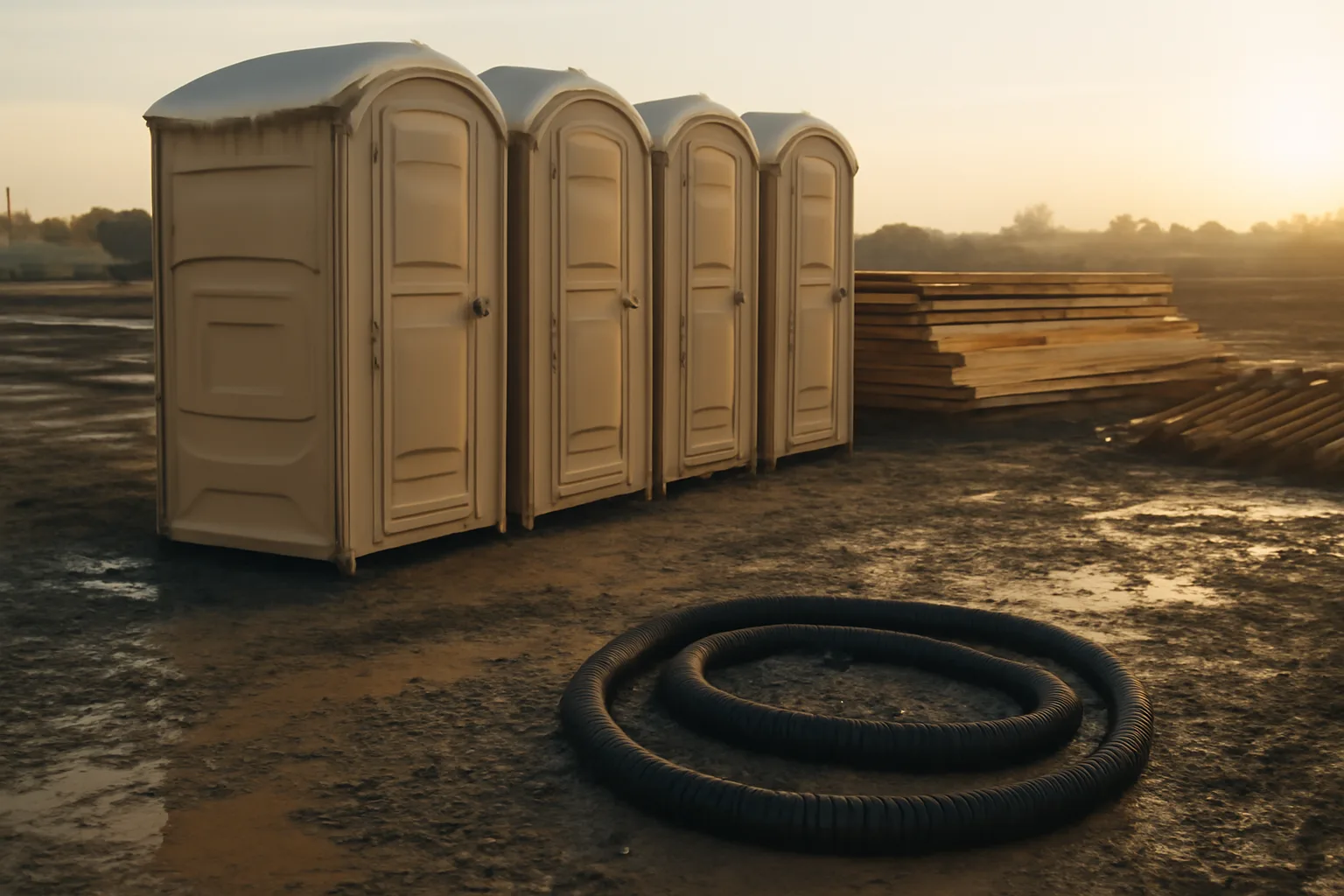
A standard unit is a molded polyethylene cabinet with a waste tank, a seat, a vent, and a door latch. You drop it. You come back on a service cycle with a vacuum truck. You add charge and deodorizer. You leave it cleaner than you found it. Construction wants weekly service. A busy weekend event may want a mid-event pump. Restroom trailers and ADA units sit in the same family, but they are not the starter product.
People mix this up with a janitorial sideline. It is not. The moment you hold other people's sewage, you sit under health rules, transporter rules, and dump-site contracts. OSHA cares because jobsites without sewers still need toilets. [1] EPA cares once that waste is applied to land or moved under state hauler rules. [4]
If you want a side-by-side with other outdoor trades, read porta potty rental vs a nearby career. The work is early, wet, and route-based. It pays when density is high and your dump point is close.
How do you start porta potty rental?
You start on paper, not on a truck lot. Form an entity and get an EIN. Then ask the state environmental agency and the local health department what they require for portable toilet rental and septage hauling. Buy equipment only after those boards answer. [8][9]
Here is the order I would follow. Pick a legal structure with the SBA outline in front of you, then file the state formation paper. Get the EIN online from IRS. Open a business bank account. Call the state office that licenses septage or waste transporters. Call the city or county health department. Ask each one, by name, whether portable toilet rental needs a separate permit, a vehicle decal, a bond, or a written dump agreement. Write down the form numbers they give you. Do not guess from a forum post.
Equipment comes after that call. A used standard fleet and one vacuum truck will launch more companies than a shiny trailer and no dump ticket. Confirm current asking prices yourself. I will not invent a national unit price here because molders and used lots move numbers every quarter.
Insurance is not a maybe. You want commercial auto on the truck and general liability on the placements. Ask a broker who already writes waste accounts about a pollution endorsement. Confirm limits with the GC or event producer who will hire you. Their contract will dictate more than a blog will.
Want the paper checklist in one packet? RestroomRoute publishes a $199 one-time Portable Restroom Launch Kit at /start. RestroomRoute is an independent publisher, not a law firm and not a hauler. The kit does not replace the board.
First jobs should be weekly construction, not a 5,000 person festival. Construction is boring and it repeats. Festivals spike, then they leave you with a Sunday night pump and a tired crew.
What license do you actually need to rent porta potties?
There is no single federal porta potty license. You stack state transporter paper, local health permits, and ordinary business registrations. Confirm every form and fee with the board that issues it. Processing times change and I will not invent them.
Most states treat the vacuum truck as a septage or non-hazardous waste transporter. Some want a vehicle-specific permit. Some want driver training records. A few fold portable toilet service into the same card as septic pumping, which matches how Census already groups the work. [3] Counties and cities may still want a health permit to place units, especially at food events.
You also need the boring licenses. Entity registration in your state. A local business tax certificate if the city uses one. A sales tax permit if your state taxes tangible personal property rentals (many do). A fictitious name if you are not trading under the legal entity name.
Do not confuse a wastewater operator certificate with a hauler permit. Operator licenses are for treatment plants. You are not running a plant. You are moving domestic septage to a plant or to a land application site that already holds its own approval. [5]
Keep a one-page permit map: issuing board, form name, renewal month, vehicle list. When an inspector asks, you hand them that page plus the cab card.
If you are comparing how other guides frame the same stack, porta potty rental guide 12 and porta potty rental guide 18 walk adjacent cuts of this question.
Do you need a CDL and a special truck?
You need a CDL when the truck meets the federal commercial motor vehicle weight thresholds, which most vacuum trucks do. 49 CFR 383.91 puts a single vehicle with a GVWR of 26,001 pounds or more in Group B. [12] Confirm the plate and the door sticker on the truck you actually buy.
Plenty of starter vacuum trucks sit on a 26,001-plus chassis because the tank, water, and debris load need the iron. Some lighter slip-in tanks on a pickup stay under the CDL line. Those lighter rigs cap how many units you can pump before you drive to the dump. I would not build a year-one plan on a light truck unless I had already walked my dump site and my route density.
Even below CDL weight, crossing 10,001 pounds GVWR can pull you into other federal motor carrier record rules if you run interstate. Confirm with the text of part 383 and your state DMV, not with a Facebook group. [12]
The truck is a mobile vacuum system. Tank, pump (often a vane pump), hose, sight glass, wash-down water, and a place for charge. Buy the pump you can service locally. A wireless tank gadget is a waste if the shop that can rebuild your pump is 90 minutes away.
Drivers need the right class, a medical card if they are in CDL work, and whatever septage training your state lists. I would pay for the CDL before I paid for wrap and a logo.
How does OSHA decide how many toilets a jobsite needs?
OSHA 1926.51 requires 1 toilet on a construction jobsite with 20 or fewer employees, and 1 toilet seat plus 1 urinal per 40 workers above that. [1] That ratio is the number GCs actually quote when they call you.
The construction standard also says job sites without a sanitary sewer get privies, chemical toilets, recirculating toilets, or combustion toilets unless local code blocks them. [1] Chemical toilets are the porta potties. OSHA wrote this product into the job before you existed as a company.
General industry uses a different table. 29 CFR 1910.141 Table J-1 starts at 1 toilet for 1 to 15 employees, then 2 toilets for 16 to 35, 3 for 36 to 55, and keeps stepping up. [2] Most of your weekday revenue still comes from 1926 work, not from factories. The chart above shows that general-industry table, so you can see the steps.
Neither standard sets your rental price. They set the minimum count. GCs add units so the walk is short and the line is short. Some project specs still recite a 200 foot walk. That figure is not in the current 1926.51 table. If a spec writer wants 200 feet, you bid the spec, not a forum argument.
I bid construction on a weekly service unless the headcount or the weather says otherwise. Heat and night shifts change the real need even when the table does not.
Where does the waste go and what does EPA 503 require?
The waste goes to a place that is allowed to take domestic septage. That is usually a wastewater treatment plant (a POTW) or a permitted land application site. EPA 40 CFR Part 503 sets pollutant, pathogen, and vector attraction rules for sewage sludge and domestic septage that is applied to land. [4] If you only dump at a POTW, the plant's local rules and your state transporter permit do more day-to-day work than 503 does.
EPA's Domestic Septage Regulatory Guidance is written for haulers who land-apply. [5] Read it if your dump plan is a field. Do not pretend you read it if your plan is a plant scale house.
Get the dump agreement in writing before you sell the first month of service. Plants cap gallons. Plants close. Plants change hours. A Saturday festival with no Sunday dump slot is how new operators ruin a weekend.
I would rather have two dump points and 40 units than one dump point and 120 units. Capacity at the plant is a hidden fleet limit.
Keep load records. State inspectors ask for dates, gallons, origin, and destination. 503 land appliers have extra pathogen and vector paperwork. [4][5] Your state may want copies in the truck.
Nobody keeps a clean public dataset for average dump fees nationwide. Call the plants in your radius and write the number they quote this month.
What does ADA require for portable toilets?
When single-user portable toilets are clustered, the 2010 ADA Standards require at least 5 percent of the units, and no fewer than one, to meet accessible toilet room rules. [6] That is the number event producers should already know.
The Standards state: "Where multiple single user portable toilet or bathing units are clustered at a single location, at least 5 percent, but no fewer than one, of the toilet units and bathing units at each cluster shall comply with 603." [6] Units that comply get identified with the International Symbol of Accessibility. The U.S. Access Board walks through toilet room clearances in its Chapter 6 guide. [7]
A true ADA unit is larger. It has grab bars, a wider door, and turning space. It is not a standard cabinet with a sticker. If you only own standard units, you will lose public-event bids and you will deserve to.
I would buy ADA units after I had a repeating construction route, not before. Construction specs sometimes ask for one accessible unit per cluster too. Read the job spec. Do not argue civil rights law in a text message with a superintendent.
Private backyard jobs rarely ask. City festivals always should. If a public entity is the customer, treat ADA as a bid requirement, not an upsell.
How much does it cost to start a porta potty rental business?
SBA tells you to list one-time costs and monthly costs before you spend. [10] I agree. The honest answer is a range, not a viral number.
Major cost blocks are the same every time. Entity and permits (board-set fees, confirm them). Truck (used vacuum chassis vary by tank size and pump hours). Units (used standard cabinets if the tanks are not cracked). Charge, tools, hose, PPE. Insurance down payment. Dump setup. A phone and a simple invoice tool. I will not publish a fake average startup cost. Public sources do not keep a current national average for this fleet mix, and repeating an old blog number is how people undercapitalize.
IRS treats the truck and the units as depreciable business property once they are in service. Publication 946 is the rulebook for method and recovery period. [13] Talk to a CPA about section 179 before you buy a pile of plastic in December just because someone on a forum did.
Start with enough units to fill two construction days, not a warehouse. Dead units in a yard do not pay for diesel. Used units are fine. Cracked tanks are not.
If you want another cut of cost framing, porta potty rental guide 24 sits next to this one.
What insurance and entity paperwork come first?
Entity first, then EIN, then bank, then insurance quotes, then equipment. SBA lays out sole prop, partnership, LLC, and corporation in plain language. [9] I would use an LLC in most states unless a CPA had a tax reason to do something else. Confirm formation fees with your secretary of state. I will not invent them.
IRS issues the EIN online for responsible parties who qualify. [8] Use the legal name that is on the formation paper. Then open a dedicated account. Mixing house money with tank money is how you lose both.
Ask for commercial auto on every powered unit and general liability for placements. Add hired and non-owned if a helper uses a personal truck. Ask a broker who already writes waste or construction service accounts about a pollution endorsement. Event contracts and GC master services agreements will name limits. Bid to those limits or walk away.
Workers' compensation comes in once you have employees. BLS tracks septic tank servicers and sewer pipe cleaners as a real occupation with published median pay. [11] If you hire, you are in that labor market. Read the current BLS number on the Occupational Outlook Handbook page. Do not copy a wage from an old thread.
A CPA and a broker cost less than a badly titled truck.
What does a first-year operating week actually look like?
Monday is construction service. You pump, charge, wipe, and move units that the GC relocated with a forklift without calling you. Tuesday is the rest of the route plus deliveries. Wednesday is repairs and the calls you ignored. Thursday looks like Monday. Friday you stage weekend event units and you still finish the construction route because those toilets do not pause for a wedding.
Service frequency is a contract term, not a vibe. Weekly is the construction default. Twice-weekly shows up on crowded sites and in heat. Events get a pre-pump, a during-pump if the producer paid for it, and a strike.
Keep a route sheet with unit IDs. When a tank is over full, you own the overflow even if the GC said they only had 12 guys. Count heads against OSHA 1926.51 and add units before the complaint. [1]
Yard work is real work. Winter means frozen tanks and cracked doors. Summer means odor calls at 6 a.m. I would rather own a parts shelf (latches, urinal screens, TP dispensers) than a second unused trailer.
Sleep matters. The operators who quit in month eight are the ones who sold Saturday festivals on top of a full construction book with one truck.
See porta potty rental guide 30 and porta potty rental guide 36 for adjacent operating notes.
Construction jobs vs events: which work should you take first?
Take construction first. It repeats every week, the count comes from OSHA, and the GC already knows they must have toilets. [1] Events pay in spikes and they need ADA units, night pumps, and a dump site that is open when the band stops.
Construction cash is slower. Net 30 or net 45 is common. Events may pay a deposit. Your cash plan has to survive the gap. I would rather invoice three GCs weekly than chase one carnival promoter across a county line.
Events also expose weak paper. Health departments show up. ADA complaints show up. If your insurance certificate is late, you sit in the lot while someone else unloads.
A restroom trailer is a different product. Water, waste, genset, winterization. It burns year-one capital if you do not already have a booked indoor-grade event. Buy trailers after standard and ADA cabinets are turning.
If you want more comparison pieces, porta potty rental guide 42 keeps going on that fork.
What paper should you confirm with the board before you buy units?
Confirm four things in writing. The state transporter or septage permit (who issues it, which vehicles, which waste codes). The local health permit if any. The dump site's acceptance letter, hours, and gallon rules. The DMV class for the truck you intend to buy. [12][5]
Then confirm sales tax treatment of portable toilet rental in your state. Some states tax the rental. Some tax only the service. Your department of revenue publishes that, not a Facebook admin.
Confirm zoning on your yard. A residential driveway full of toilets and a dripping hose will get a code visit. A light industrial lot with a wash pad is the adult version of this business.
I do not trust a verbal you-are-fine from a clerk. Ask for the form name and the statute or code section. If they cannot name it, ask a supervisor. RestroomRoute will point you at a launch checklist at /start, but the board still wins every argument.
Last check. Read OSHA 1926.51 and 1910.141 yourself so you can talk counts with a superintendent without blinking. [1][2] Read the NAICS description so your banker files you in the right box. [3] Then buy the plastic.
Frequently asked questions
What is porta potty rental?
Porta potty rental is placing, servicing, and hauling portable toilets for jobsites and events. The Census Bureau files the trade under NAICS 562991 with septic pumping. You own or lease the units, run a vacuum truck on a route, and dump at a legal plant or land-application site. It is waste logistics, not a cleaning sideline.
How do you start porta potty rental?
Form an entity, get an IRS EIN, then call the state septage or waste-transporter board and the local health department before you buy a single cabinet. Confirm permits, dump access, and the truck's CDL class in writing. Add commercial auto and general liability. Start on weekly construction, not festivals. Confirm every fee with the issuing board.
What NAICS code is porta potty rental?
The Census Bureau classifies porta potty rental and septic pumping together under NAICS 562991. The official description covers pumping septic tanks and cesspools and renting or servicing portable toilets. Use that code on bank, insurance, and some permit forms so you are not filed as generic construction or janitorial.
Do I need a CDL to haul portable toilets?
You need a CDL if the vacuum truck's GVWR is 26,001 pounds or more. 49 CFR 383.91 puts that single vehicle in Group B. Many vacuum chassis sit over that line. A light slip-in tank on a pickup may stay under it, but that also caps route volume. Read the door sticker and confirm with your state DMV.
How many porta potties does OSHA require on a construction site?
OSHA 1926.51 requires 1 toilet on a construction jobsite with 20 or fewer employees, and 1 toilet seat plus 1 urinal per 40 workers above that. Sites without a sanitary sewer may use chemical toilets. General industry uses the steeper 1910.141 Table J-1 instead. Bid the spec if it is stricter than the federal minimum.
Is porta potty waste regulated by the EPA?
Yes, when domestic septage is applied to land. EPA 40 CFR Part 503 sets pollutant, pathogen, and vector rules for that path. If you dump at a wastewater treatment plant, the plant's local rules and your state transporter permit usually control the day. EPA's Domestic Septage Regulatory Guidance is the self-help text for land appliers.
Are ADA portable toilets required at events?
When multiple single-user portable toilets are clustered, the 2010 ADA Standards require at least 5 percent of the units, and no fewer than one, to comply with accessible toilet room rules in section 603. A public event should treat that as a bid requirement. A true ADA unit is larger, with grab bars and turning space, not a sticker on a standard cabinet.
Can I start with used porta potties?
Yes, if the tanks are sound, the doors latch, and you can still brand and clean them. Cracked tanks are a leak you will own. I would buy used standard cabinets for year one and skip restroom trailers until construction routes are repeating. Confirm current asking prices on the lot. Nobody publishes a stable national used-unit index.
Do I need a wastewater operator license?
Usually no. Operator certificates are for people who run treatment plants. Porta potty rental is hauling and servicing. You need the state septage or waste-transporter paper that applies to the truck, plus any local health permit for placements. Confirm both with the issuing boards. Do not apply for a plant operator card unless a board named that card.
How often should a porta potty be serviced?
Weekly is the construction default. Twice-weekly shows up on crowded sites and in heat. Events need a pre-event pump, sometimes a mid-event pump, and a strike. Put the cycle in the contract. OSHA sets unit counts, not pump days. If a tank is over full, add service or add units before the complaint, even if the headcount looked small on paper.
Can I run porta potty rental from my house?
Maybe for the office, rarely for the yard. Confirm zoning before the first unit sits overnight. A residential driveway with toilets and a dripping hose draws code complaints. A light industrial lot with a wash pad is the adult version. Home occupation rules and HOA rules are local. Ask the zoning desk for the code section, not a shrug.
What is the difference between a restroom trailer and a porta potty?
A porta potty is a self-contained polyethylene cabinet with a waste tank. A restroom trailer is a wheeled room with fixtures, a larger waste tank, often fresh water, and usually a genset or shore power. Trailers cost more, need winterization, and bid a different event. They are a weak year-one buy if standard and ADA cabinets are not already turning.
Do I need a written dump agreement?
Yes, before you sell the first month of service. Plants cap gallons, change hours, and close. A verbal maybe will not help you on a Sunday after a festival. Get acceptance, hours, waste type, and price in writing. If you land-apply instead, you are in EPA 503 and state land-application paper, which is a different stack. Confirm with the plant or the state board.
How far should a jobsite toilet be from the work?
OSHA 1926.51 sets counts, not a walk distance in the current toilet table. Some job specs still recite 200 feet. If the spec says 200 feet, bid that layout. If it does not, place units so people actually use them. A legal count that sits a long walk away still produces overflow and complaints. Read the project spec before you argue.
Sources
- OSHA, 29 CFR 1926.51 Sanitation: Construction jobsites need 1 toilet for 20 or fewer employees, and 1 toilet seat and 1 urinal per 40 workers above that; sites without a sanitary sewer may use chemical toilets.
- OSHA, 29 CFR 1910.141 Sanitation Table J-1: General industry Table J-1 sets minimum toilets at 1 for 1-15 employees, 2 for 16-35, 3 for 36-55, and further steps by headcount.
- U.S. Census Bureau, NAICS 562991 Septic Tank and Related Services: NAICS 562991 covers establishments pumping septic tanks and cesspools and/or renting and servicing portable toilets.
- U.S. EPA, 40 CFR Part 503 Standards for the Use or Disposal of Sewage Sludge: Part 503 sets pollutant, pathogen, and vector attraction requirements for sewage sludge and domestic septage applied to land.
- U.S. Department of Justice, 2010 ADA Standards for Accessible Design: Where multiple single-user portable toilet units are clustered, at least 5 percent but no fewer than one must comply with section 603.
- U.S. Access Board, Guide to the ADA Standards Chapter 6 Toilet Rooms: The Access Board explains accessible toilet room clearances and related 2010 Standards requirements used for ADA portable units.
- IRS, Apply for an Employer Identification Number (EIN) Online: IRS issues EINs online to qualifying responsible parties as the federal tax ID for a new business.
- U.S. Small Business Administration, Choose a business structure: SBA outlines sole proprietorship, partnership, LLC, and corporation options for new firms.
- U.S. Small Business Administration, Calculate your startup costs: SBA instructs founders to list one-time and monthly startup costs before spending.
- U.S. Bureau of Labor Statistics, Occupational Outlook Handbook: Septic Tank Servicers and Sewer Pipe Cleaners: BLS publishes current median pay and occupation data for septic tank servicers and sewer pipe cleaners, the closest federal wage series for this field work.
- eCFR, 49 CFR 383.91 Commercial motor vehicle groups: Group B covers any single vehicle with a GVWR of 26,001 pounds or more, the usual CDL class for a vacuum truck.
- IRS, Publication 946 How To Depreciate Property: Trucks and portable toilet units placed in service are depreciable business property under the methods and recovery periods in Pub. 946.