Last updated 2026-08-19
TL;DR
Porta potty rental is short-term hire of portable toilets plus the pumping that keeps them legal. Start with an entity, a free IRS EIN, your state hauler or portable sanitation credential, and a treatment-plant dump contract before you buy units. OSHA's construction table starts at 1 toilet per 20 workers. Confirm every form and fee with the board that issues your card.
What is porta potty rental?
Porta potty rental is the short-term placement and servicing of portable toilets and wash units for construction, events, farms, and emergency sites. You own or lease the boxes, you haul them, and you pump the waste on a set cycle. The customer pays for access and cleanliness, not for a building.
That is the whole product. It is sanitation plus logistics. It is not party décor.
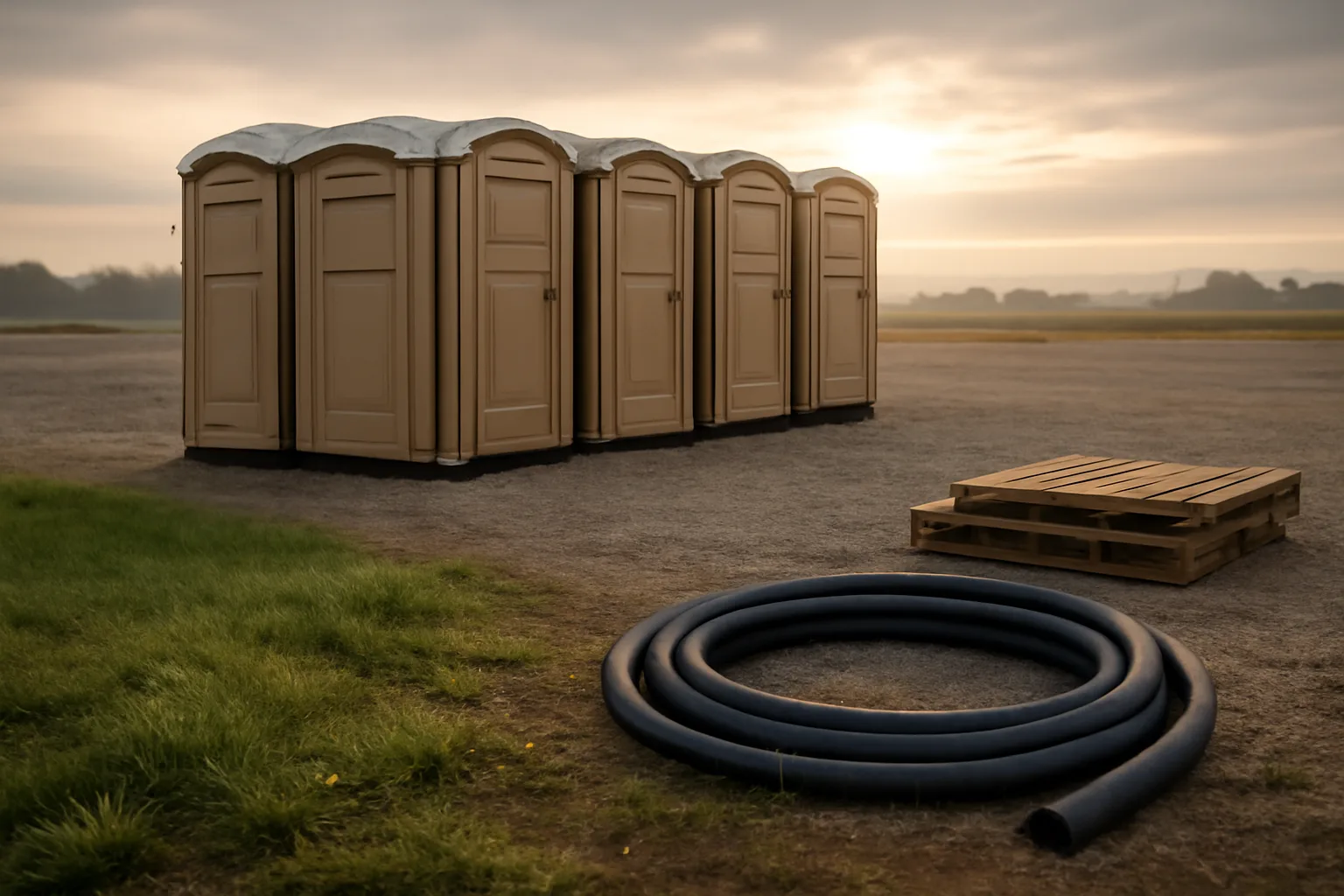
A standard unit is a molded polyethylene cabin with a holding tank, a seat, a vent, and a door latch. Many fleets add a hand-wash station because food vendors and some health desks want water nearby. Construction usually sits on weekly service. A dense weekend festival can need a daily pump. This porta potty rental guide 105 is the paper path for that work, not a national myth about easy weekend money.
The Census Bureau files this work under NAICS 562991, Septic Tank and Related Services, the same bucket as septic pumping [11]. Lenders look for that code. OSHA 29 CFR 1926.51 Table D-1 requires 1 toilet for a construction crew of 20 or fewer employees [1]. That sentence is the one most contractors already know.
Customers split in two. Contractors want a standing weekly route. Event producers want a delivery window and a Sunday pickup. Price them on different sheets. Mix them blindly and your Saturday truck will lose money.
If someone tells you this is just like renting tents, ignore them. The waste rules sit closer to a pumper shop than to a party closet.
How do you start porta potty rental?
You start by lining up a legal identity, a legal dump point, and a service truck before you buy a row of new units. Form an entity (most people use an LLC), get a free EIN from the IRS, then call the state board that licenses septage haulers or portable sanitation [7][8]. Buy the toilets last.
That order saves money. A stack of units with nowhere legal to dump is scrap plastic.
The SBA walkthrough on business structure is enough for the entity decision [9]. A single-member LLC taxed as a sole prop is what I would file unless you have a partner or outside capital. Apply for the EIN online. It is free. Anyone charging you for an EIN is selling a click you can do yourself [8].
Then the hard call. Ask your state environmental or health department what credential covers pumping portable toilets. Some states fold it into a septage pumper license. Some want a separate portable sanitation registration. Some counties add a waste hauler permit on top. Confirm the current form and fee with that board. Do not trust a blog fee table if the legislature moved last session.
Lock a disposal agreement with a publicly owned treatment plant or a licensed receiving site before you take the first job. EPA rules treat portable toilet contents as domestic septage [4][14]. Plants set their own receiving hours and ticket rules.
Only then price a used vacuum truck and a starter set of standard units. I would skip restroom trailers in year one. They need water, power, and a different damage waiver. Insurance binds after you can describe the truck GVWR and the dump site.
Paper you will actually use: the hauler credential, the dump tickets, the certificate of insurance, and a one-page rental contract. If you want that paper path in one binder, RestroomRoute sells a $199 one-time Portable Restroom Launch Kit. You do not need it to finish this guide.
How many porta potties does OSHA require on a jobsite?
OSHA requires 1 toilet for a construction crew of 20 or fewer employees, then another toilet for each additional 20 workers, under 29 CFR 1926.51 Table D-1 [1]. That is the number general contractors will quote you.
The regulation says, “Toilets shall be provided for employees according to the following table” [1]. Table D-1 runs 1 unit at 20 or fewer, 2 at 21 to 40, 3 at 41 to 60, 4 at 61 to 80, and 5 at 81 to 100. Over 100, add 1 toilet per each additional 20 employees.
| Crew size (employees) | Minimum toilets |
|---|---|
| 20 or fewer | 1 |
| 21 to 40 | 2 |
| 41 to 60 | 3 |
| 61 to 80 | 4 |
| 81 to 100 | 5 |
| Over 100 | 1 more per each 20 |
You are usually the vendor, not the controlling employer. The contractor still holds the OSHA duty. Your job is to place enough units and keep them usable so the crew can meet that table. An overflowing unit does not count.
California writes a parallel construction rule at Title 8 section 1526 [10]. If you run work there, read that section and the state board notes rather than assuming federal text is the last word. Other states adopt OSHA or write their own jobsite sanitation codes.
General industry (factories, warehouses) sits under 29 CFR 1910.141, which prefers sewered toilets and allows other systems when sewers are not practical [2]. Events and farms are often local health code, not OSHA. Ask the event permit desk what ratio they printed on the application. There is no single national event ratio with the force of Table D-1.
Print Table D-1 on the back of your construction quote. It ends the “can we share one box for 45 guys” argument before it starts.
Do you need a license for porta potty rental?
You almost always need a local business license plus a waste or sanitation credential. The second one is the one that can stop you cold.
There is no single federal porta potty operator license. EPA regulates what you do with the waste [4][14]. OSHA regulates toilets at covered jobsites [1]. FMCSA regulates the truck once it crosses commercial thresholds [6][13]. The operator card comes from your state, and sometimes your county.
Call the environmental quality department and the health department both. Ask for septage hauler, portable toilet, and liquid waste vehicle. Write down the statute number they cite. Then confirm the current application and fee on that board’s form page.
State board notes help you start the call list. West Coast operators should read the porta potty rental board in california first. Florida work starts with porta potty rental board in florida. Georgia and Arizona have their own paper: porta potty rental board in georgia and porta potty rental board in arizona.
Some states treat you like a septic pumper. Some want vehicle decals. A few want proof of a dump contract in the packet. I would not order truck lettering until the board tells you what must appear on the tank.
City business tax certificates are boring and real. Get them. Parking a yard of toilets in a residential driveway will earn you a zoning complaint. Check the zoning desk before you sign a lot lease.
What equipment do you actually need in year one?
Year one you need standard units, a way to move them, a vacuum tank that can pump them, and a legal yard. Restroom trailers can wait.
A starter construction fleet is often 20 to 50 standard units plus a couple of accessible units. I do not have a government price index for the boxes. Manufacturer quotes move with resin and freight. Get three written quotes the same week. Used units are fine if the doors latch and the tanks are not cracked. Cracked tanks leak, and leaks cost you plant access.
The truck is the business. Many operators run a light or medium duty chassis with a few hundred to about 1,500 gallons on the tank (confirm the data plate, not a forum post). Cross 26,001 pounds GVWR and you are in CDL territory [6][13]. I would rather run a lighter legal truck in year one than rush a Class B and a medical card before the routes exist.
You also need a trailer or flatbed for deliveries if the pump truck is not set up to haul units. Ramps, a dolly, extra padlocks, winter bowl treatment if you work a cold state, and a spare set of door springs. That last one keeps Saturday calls down.
Skip the custom wrap in month one. Skip the luxury trailer. Skip buying 200 units because a broker promised you a solar farm. Own the dump ticket process first. Hand-wash stations sell next to food tents. They also freeze. Budget for that if you chase events.
How do you dump porta potty waste legally?
You dump at a facility allowed to take domestic septage, or you land-apply only if you meet 40 CFR Part 503 and your state still allows it. Most new operators should use a treatment plant.
EPA’s definition is blunt. “Domestic septage is either liquid or solid material removed from a septic tank, cesspool, portable toilet, Type III marine sanitation device, or similar treatment works that receives only domestic sewage” [4]. Porta potty waste sits inside that sentence.
Land application runs through 40 CFR 503.32, which sets pathogen reduction and site rules for domestic septage [5][14]. Lime stabilization is the method older pumpers still talk about. I would not start there. Plant receiving is simpler, and the ticket is your proof.
Call the POTW industrial pretreatment or residuals desk. Ask if they take portable toilet waste, what the per-gallon or per-load fee is this quarter, what hours the gate is open, and whether they need a hauler number on the manifest. Confirm those facts with the plant. Fees change.
Keep every dump ticket. If a county inspector asks where Friday’s load went, you want a paper answer the same day. Mixing grease or shop waste into a toilet tank is how people lose plant access. Train whoever holds the hose.
Do you need a CDL or a USDOT number?
You need a CDL when the truck you actually drive meets federal commercial motor vehicle thresholds, most often a GVWR of 26,001 pounds or more [6][13]. Read the door-jamb sticker, not the sales brochure.
49 CFR 383.91 sets the groups. A single vehicle at 26,001 pounds GVWR or more is generally Group B [6]. Combined weights can push you to Group A. A hazardous materials endorsement is a separate question and usually does not apply to domestic septage, but confirm with your state driver handbook rather than a Facebook group.
A USDOT number is a separate FMCSA registration question. Interstate commerce and many commercial weights trigger it [7]. Intrastate-only rules vary. Use FMCSA’s own “Do I Need a USDOT Number” page, then ask your state patrol motor carrier desk [7].
I would spec year-one trucks to stay under the CDL line if the tank size still lets you finish a day. The moment routes need a much larger tank, budget time for the CDL, the medical examiner certificate, and the extra insurance class.
Do not let an unlicensed helper “just run the big truck this once.” That is how you buy a lawyer.
What ADA rules apply to portable toilets?
When portable toilets are clustered, the 2010 ADA Standards use a 5 percent accessible share for that cluster, and you still need at least one. Event producers will point to the Access Board text [3].
Section 213.2 Exception 3 is the portable-unit rule. Where multiple single-user portable toilet units are clustered at a single location, no more than 5 percent of the units at each cluster must meet the accessible toilet-room provisions [3]. In practice that means at least 5 percent, and at least one, in each cluster. Scatter units across a fairground and each cluster is its own math problem.
Construction jobsites are messier. OSHA’s table is about count, not accessibility [1]. Public events, parks, and local building officials often import the ADA 5 percent rule anyway. If the buyer is a city or a school, expect the accessible unit in the bid.
An accessible portable toilet is larger, has grab bars, and a ramp or a low threshold. It takes more trailer space. I keep a dedicated pair and do not let sales promise them on two sites the same Saturday.
This is civil rights law when the site is covered, not optional décor. Confirm with the event’s permitting agency whether the cluster rule applies to that venue.
What insurance and paper should you carry?
Carry commercial auto on the real GVWR, general liability, and a pollution or contractors environmental form that names hauled septage. Ask the agent to put the dump site and the yard address on the schedule.
I will not invent a premium. Two local agents who already write pumpers will beat any national number I could type. Bring them the truck spec, the max gallons, and whether you do special events.
Paper that actually gets requested includes entity documents and the EIN letter [8][9], the state hauler or portable sanitation credential, dump agreements or recent tickets [4], a certificate of insurance with additional-insured language for general contractors, a CDL and medical card if the truck requires them [6], a rental contract that states service interval and damage, and IRS records for truck and unit costs under Publication 535 [12].
Write service dates on every invoice. Construction PMs forward those to safety files.
Carry workers’ comp once you have employees. Pay them as employees if they are employees. Misclassifying a weekend driver is a bad bet.
What does first-year porta potty rental operations look like?
First-year operations are a route math problem. You win by keeping the truck full of paying pumps and short on empty miles.
Weekly construction service is the backbone. Bid sites that sit on one corridor. A scattered map of one-off backyard parties will burn diesel and Saturdays. I would take three boring subdivision contracts over one viral wedding account.
Service interval is a contract term, not a vibe. Weekly is common on small crews. Heavy manned sites and hot weeks need a midweek stop. Skip a pump to save a trip and you will get the overflow photo at 6 a.m.
Winter is its own job. Plastic gets brittle, locks freeze, and tanks slosh. Use the cold-weather additive your chemical supplier actually specs. Theft happens. Cheap padlocks and a fenced yard beat a police report.
Keep a simple unit log: stencil number, site, last pump, last repair. When a GC says you never showed up, the log is the whole argument.
Cash flow hurts in month two because you bought tanks before invoices aged. Require a delivery deposit on events. Net-30 is fine for a GC you checked. It is not fine for a one-weekend promoter you cannot find on Monday.
How should you price porta potty rental?
Price from your cost per service stop, not from a number you heard at a trade show. There is no official national rate.
Build the stop cost from diesel, dump fee, labor minutes, truck payment, unit wear, insurance, and the empty miles. Then add margin. Publication 535 is how you think about depreciation for tax, not how you quote a customer [12].
Construction weekly rental is usually a four-week or monthly price plus a trip charge if the site sits outside your zone. Events are a weekend package with a delivery window and a damage hold. Do not use the same SKU for both.
If a competitor is far cheaper, they are skipping dumps, skipping insurance, or lying. Match them and you join them.
Print a one-page rate sheet with three zones and two unit types (standard and accessible). Specialties such as flush units or trailers get quoted only after you own them. Confirm the current plant dump fee every quarter. That line moves, and it should move your price.
Which state board should you call first?
Call the board that prints the hauler credential before you buy truck lettering. Start with your environmental quality or health department, then your county.
We keep state pages for the board list and the statutes they actually cite. Use them as a call sheet, then confirm live. Alabama paper is not Colorado paper. Start with porta potty rental board in alabama or porta potty rental board in colorado if that is your map. Mountain West operators can use porta potty rental board in idaho. Arkansas questions on whether a license even exists belong on Do You Need a License for Porta Potty Rental in Arkansas?.
No article can promise approval or a processing time. Boards change forms. If a page here conflicts with the PDF on the agency site, the PDF wins.
RestroomRoute is an independent publisher, not a law firm and not a pumper. For a paper binder of the startup path, the $199 Portable Restroom Launch Kit is at /start. Use this guide either way.
Frequently asked questions
What is porta potty rental?
Porta potty rental is short-term hire of portable toilets, hand-wash stations, and the pumping that keeps them usable. You deliver units, service the tanks on a contract cycle, and pick them up. The Census NAICS code is 562991. It is sanitation logistics, not party décor, and the waste is regulated as domestic septage under 40 CFR Part 503.
How do you start porta potty rental?
Form an entity, get a free IRS EIN, then get the septage or portable sanitation credential your state actually issues. Lock a treatment-plant dump contract before you buy toilets. Spec a vacuum truck after you know the GVWR and CDL line. Confirm every fee and form with the board. Units come last.
How many porta potties do I need for a construction site?
OSHA 29 CFR 1926.51 Table D-1 requires 1 toilet for 20 or fewer construction employees, 2 for 21 to 40, and 1 more per each additional 20 workers. You still have to keep those units pumped or they do not count. Events use local health ratios, not that table. Confirm the event permit desk number.
Do I need a CDL to run a pump truck?
You need a CDL when the vehicle meets federal commercial thresholds, most often a GVWR of 26,001 pounds or more under 49 CFR Part 383. Read the door sticker. A lighter truck can keep you out of Class B in year one. Confirm endorsements and medical-card rules with your state driver handbook.
Is porta potty waste regulated as domestic septage?
Yes. 40 CFR 503.9 defines domestic septage to include material removed from a portable toilet that received only domestic sewage. Most new operators should dump at a POTW and keep the tickets. Land application is a 503.32 problem plus whatever your state still allows. Confirm the plant’s current receiving rules.
How many ADA portable toilets do I need?
The 2010 ADA Standards (Access Board section 213.2) use a 5 percent accessible share when single-user portable toilets are clustered, with at least one in the cluster. Each cluster is counted separately. Cities and schools often write that into the bid. Confirm with the venue’s permitting agency.
Can I start porta potty rental from my house?
You can form the entity from a home office. Parking a yard of units and a vacuum truck on a residential lot is a zoning fight you will probably lose. Check the zoning desk and any HOA rules before the first delivery. A small fenced industrial yard is the cleaner first-year move.
What NAICS code is porta potty rental?
The Census Bureau classifies this work as NAICS 562991, Septic Tank and Related Services. That code also covers septic pumping. Banks, insurers, and some license applications ask for it. Use 562991 unless your accountant has a written reason to file something else.
Do I need a special license in every state?
There is no federal operator card. Each state (and sometimes each county) writes the septage hauler or portable sanitation credential. If you cross a state line to pump, expect a second set of paper. Confirm with both boards before the first interstate load. Do not assume reciprocity.
How often should units be pumped?
Put the interval in the contract. Weekly is common on small construction crews. Hot weather, large crews, and food-heavy events need more stops. OSHA’s table is about unit count, not pump days. If the tank is full, the unit does not meet the jobsite duty. I would rather over-service than argue from an overflow photo.
Are restroom trailers a good year-one buy?
Usually no. Trailers need water, power, a different damage waiver, and more recovery skill when something breaks on a Saturday. Standard units plus a reliable dump contract build the route. Add a trailer after you have event demand that already pays for the extra chassis.
What dump records should I keep?
Keep every plant ticket with date, gallons or load count, truck ID, and facility name. EPA 503 and most state hauler rules expect you to show where domestic septage went. A spreadsheet plus paper tickets is enough in year one. If an inspector calls on Monday, you want Friday’s load on one page.
Is an EIN required if I have no employees?
The IRS issues a free EIN online, and you will want one for a business bank account, many dump contracts, and most insurers even with no staff. You apply on the IRS EIN page. Do not pay a reseller. Confirm with your tax preparer if you remain a sole prop without an entity.
What insurance do porta potty rental companies carry?
Plan on commercial auto matched to GVWR, general liability, and a pollution or hauled-waste endorsement that names septage. Add workers’ comp when you have employees. I will not invent a premium. Get two quotes from agents who already write pumpers and bring them the tank size and dump site.
Sources
- OSHA 29 CFR 1926.51 Sanitation: Table D-1 requires 1 toilet for 20 or fewer construction employees and additional toilets by crew size; toilets shall be provided according to that table.
- OSHA 29 CFR 1910.141 Sanitation: General industry sanitation rules require toilet facilities and allow non-sewered systems when sewered toilets are not practical.
- U.S. Access Board 2010 ADA Standards section 213.2: Where portable toilet units are clustered, no more than 5 percent of the units at each cluster must meet accessible toilet provisions.
- eCFR 40 CFR 503.9 Definitions: Domestic septage includes liquid or solid material removed from a portable toilet that receives only domestic sewage.
- eCFR 40 CFR 503.32 Pathogens: Part 503 sets pathogen reduction and related requirements that apply when domestic septage is treated or land-applied.
- eCFR 49 CFR 383.91 Commercial motor vehicle groups: A single vehicle with a GVWR of 26,001 pounds or more is generally a Group B commercial motor vehicle requiring a CDL.
- FMCSA Do I Need a USDOT Number: FMCSA explains when interstate commerce and commercial vehicle operations require a USDOT number.
- IRS Apply for an EIN online: Businesses can apply for an Employer Identification Number online at no charge from the IRS.
- SBA Choose a business structure: SBA guidance covers choosing a legal structure such as an LLC before launch.
- California Title 8 section 1526 Toilets at Construction Jobsites: California sets its own construction jobsite toilet rule at Title 8 section 1526, separate from the federal OSHA table.
- U.S. Census Bureau NAICS 562991: NAICS 562991 covers septic tank and related services, the classification used for portable sanitation and pumping.
- IRS Publication 535 Business Expenses: Publication 535 is the IRS reference for deducting and depreciating business equipment and vehicle costs.
- eCFR 49 CFR 383.5 Definitions: Federal CDL definitions use a 26,001-pound GVWR threshold in the commercial motor vehicle definition.
- EPA Plain English Guide to the Part 503 Biosolids Rule: EPA’s Part 503 plain-English guide explains how domestic septage is regulated under the biosolids rule.