Last updated 2026-08-19
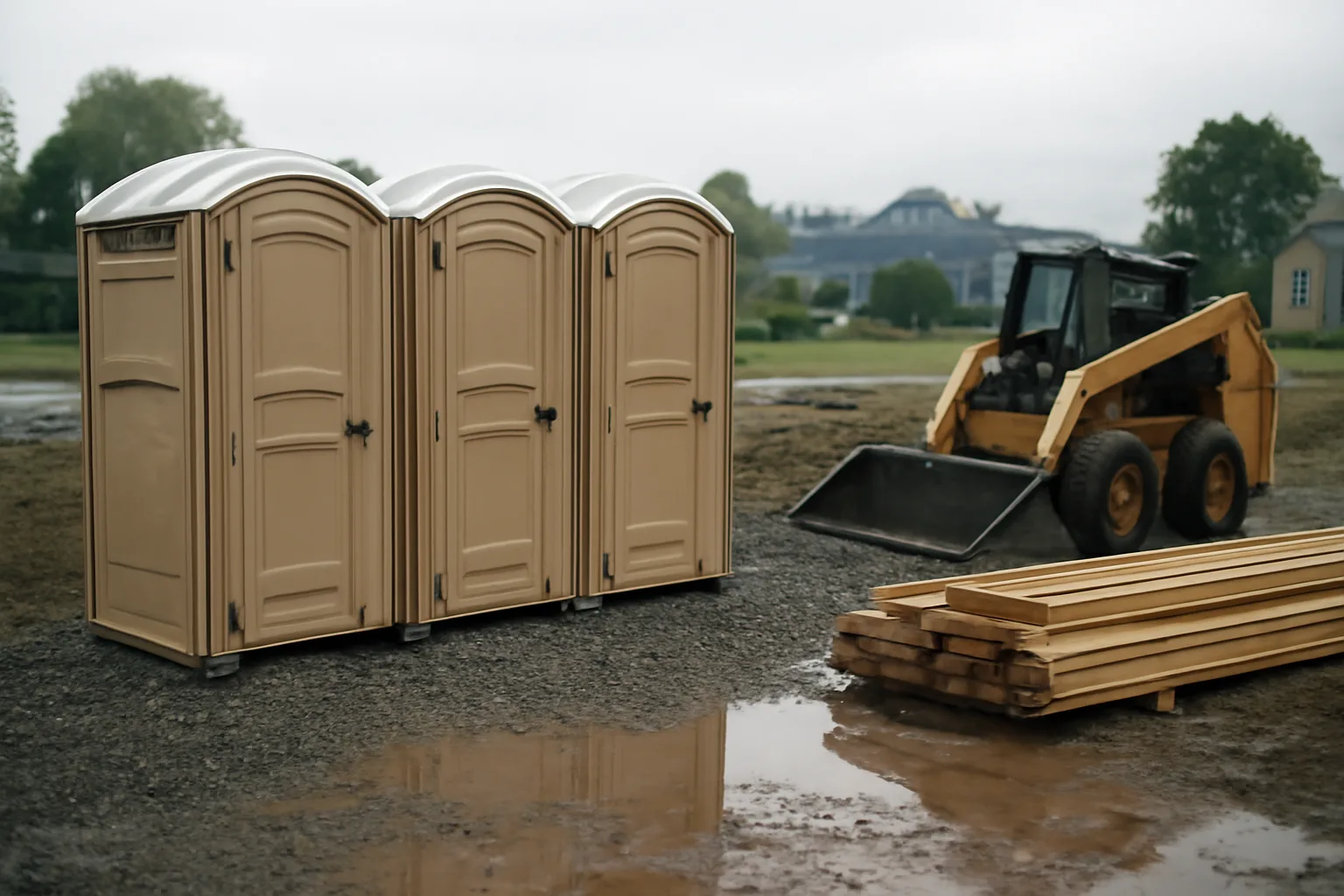
TL;DR
Porta potty rental is the hire and service of portable toilets, usually for construction and events. You drop units, pump them, and haul waste to a permitted plant or land-application site. Starting means an entity, an EIN if IRS requires one, insurance, and hauler plus disposal paper from your state and county. OSHA sets construction toilet counts. No single national rental license exists. Confirm every board.
What is porta potty rental?
Porta potty rental is paid placement and service of portable toilets. You deliver a unit, keep the tank and the cabin usable, then haul the waste and pull the box when the job ends. Construction weeks and event weekends make up most of the work. The product is sanitation on a clock, not a plastic shed sitting in a yard.
The U.S. Census Bureau files this work under NAICS 562991, Septic Tank and Related Services. That industry includes establishments primarily engaged in pumping septic tanks and cesspools and in renting and servicing portable toilets. [10] You sit next to pumpers. You do not sit next to tent companies, even when a wedding paid the invoice.
A standard loop looks like this. A general contractor wants four units on a 12 week site. You drop them, service them weekly, add a winter enclosure if the weather turns, then pull them. An event planner wants twenty units from Friday night to Sunday noon, with a Saturday pump. Same tanks. Different clock.
You make money on rental days, service trips, delivery fees, damage waivers, and extras such as hand-wash stations or solar lights. You lose money on bad disposal math, missed pumps, and units that never leave the yard.
I treat this as a route business. Density beats a pretty website. If two towns sit an hour apart and both want Saturday service, one of those accounts is a problem you chose.
The federal layer you will actually meet is sanitation counts on construction (OSHA 29 CFR 1926.51) and how domestic septage can be treated if you land-apply it (EPA 40 CFR Part 503). [1] [3] Almost everything else is state hauler paper and a local plant.
How do you start porta potty rental?
You start by locking a legal place to dump, then you form the company, then you buy iron. Reverse that order and you own tanks with nowhere to empty them. Call the wastewater plant and the state program that runs septage or biosolids before you bid on a single Saturday job.
Form an entity your state recognizes. The U.S. Small Business Administration walks through sole proprietorships, LLCs, and corporations, and it puts the tax and liability tradeoffs on you and your CPA. [7] Get an EIN from IRS if you have employees or if your bank and vendors want one. IRS lists the triggering cases on its Do You Need an EIN page. [4]
Register the business where your state and city require it. SBA's licenses and permits page is plain: what you need depends on your activities, where you operate, and government rules. [6] There is no single federal porta potty license.
Then collect the operating paper. That means a pumper or septage-hauler registration if your state has one, a written acceptance letter from a treatment plant or a land-application site that can take domestic septage, vehicle and tank rules, and insurance certificates general contractors will actually accept. Confirm every current fee and form with the board that issues it. Nobody here can promise a processing time.
Only after that do I shop used units and a service truck. Units without a dump ticket are lawn ornaments.
Do you need a special license to rent porta potties?
No single federal license covers porta potty rental. You usually stack an entity registration, a local business license, and whatever pumper, septage, or wastewater-hauler credential your state uses. Some counties add a health permit for event work. Confirm the current list with the agency that collects the fee.
SBA states that licenses and permits depend on your business activities, location, and government rules. [6] That is the whole national story. The interesting paper is local.
States treat portable toilet waste as domestic septage or a close cousin. If you land-apply, you step into 40 CFR Part 503, which sets pathogen and vector rules for that waste. [3] [11] If you only tip at a publicly owned treatment works, the plant's hauler rules and your state's transporter rules matter more than Part 503's land-application tests.
I would not spend money on a trademark or a custom wrap before the hauler number is in your cab. The gate guard wants a certificate of insurance and a unit that does not smell. The plant operator wants a ticket.
IRS Publication 583 is the federal tax starter document for people opening a business. It covers records, identification numbers, and how you report. [5] It does not replace a state wastewater chapter.
If someone sells you a national porta potty license, walk away.
What OSHA toilet counts apply on construction sites?
On construction jobs, OSHA 29 CFR 1926.51 sets the toilet count. For 20 or fewer employees the table is one facility. From 21 to 199 workers it is one toilet seat and one urinal per 40 workers. At 200 or more it is one seat and one urinal per 50 workers. [1]
OSHA 29 CFR 1926.51 requires one toilet facility for 20 or fewer construction employees. That sentence is the one GCs already know.
The same section says, "Under temporary field conditions, provisions shall be made to assure not less than one toilet facility is available." [1] That is why a two-person punch-list crew still needs a unit if nothing else is close.
OSHA lists chemical toilets as an allowed option when the site has no sanitary sewer, along with privies, recirculating toilets, and combustion toilets, unless local codes ban them. [1] That list is the statutory hook for a rental company.
| Crew size | OSHA minimum (Table D-1) |
|---|---|
| 20 or fewer | 1 toilet facility |
| 21 to 199 | 1 seat and 1 urinal per 40 workers |
| 200 or more | 1 seat and 1 urinal per 50 workers |
General industry (factories, warehouses) uses 29 CFR 1910.141, which is a different table. [2] Do not quote the construction table to a plant manager and expect it to fit.
GCs will still ask for more units than the minimum. Mud, split shifts, and a long walk from the fifth floor will do that. I bid the OSHA floor, then I ask how far the farthest worker walks.
Mobile crews with a ride to nearby toilets can fall under a narrow exception in the same section. Read the text. Do not assume your customer qualifies.
How do you legally dump porta potty waste?
You dump only where a permit holder said you can. Typical doors are a municipal or regional wastewater plant that takes hauled waste, a privately permitted septage facility, or agricultural land application that meets 40 CFR Part 503. [3] [11] Wild dumping is a crime. I will not help anyone dress that up.
If you land-apply domestic septage, EPA's pathogen rule is specific. 40 CFR 503.32 states: "The pH of the domestic septage shall be raised to 12 or higher by alkali addition and, without the addition of more alkali, shall remain at 12 or higher for 30 minutes." [3] Lime is the usual alkali. Keep the log. Inspectors ask for the log.
Part 503 also states its purpose and defines domestic septage. Read 503.1 and 503.9 before you take a farmer's handshake as a permit. [11] [14]
Most first-year operators should tip at a plant. Land application is a second business. It has site restrictions, vector attraction rules, and neighbors who vote.
Plants set their own receiving hours, grit rules, and ticket prices. Those numbers move. Confirm with the plant, not with last year's forum thread.
Some states require a trip ticket or manifest from pull to plant. Carry copies. A trooper at a scale house does not want a story.
What equipment do you need in year one?
Year one you need toilets people will actually sit in, a way to move them, and a way to pump them. That means a small yard of standard units, at least one accessible unit if you want public events, a trailer or flatbed, and a vacuum truck or a contract with someone who owns one.
I would not buy a new vacuum truck on day one unless the bank already loves you. Contract pumping while you learn routes is boring and smart. Buying 80 stained units from a retiring route that dies in 90 days is a classic way to light money on fire.
Hand-wash stations matter on food sites and many events. Solar lights matter on winter construction. Flush units and restroom trailers are a different capital stack. Skip them until standard boxes cash-flow.
No honest national price list exists for used units or used trucks that I can cite here. Manufacturer quotes and local used markets move. Get three current quotes. Anyone publishing a single startup total is guessing.
The toilets do not create a CDL problem. The truck might. If the service vehicle's GVWR hits the commercial line in 49 CFR 383.91, you need the right class. [9]
How many porta potties should you buy first?
Buy enough units to cover one dense route plus a spare pile for swaps. I would rather own 25 clean boxes and a reliable pump plan than 100 tired ones. Dead inventory still needs yard space and still gets stolen.
Construction is the volume teacher. A handful of GCs with weekly service will teach you pumping time, winter freeze, and invoice lag better than twelve weddings.
Match the buy to disposal capacity. If the plant will only take you two mornings a week, your fleet size has a ceiling you cannot negotiate away.
Accessible units are slow movers on pure construction and expected on a lot of public events. Own one or two if events are in the plan. Do not let them be your whole first invoice.
There is no federal minimum fleet size. Ignore anyone who recites one.
Spares exist because a unit will get hit by a loader. A door latch will fail on a Saturday. If you have no spare, you are the person driving 80 miles with one box at dusk.
Used units can be fine. Smell the tank. Check the door alignment. Look at the skids. A cheap unit that leaks on the customer's gravel becomes an expensive unit.
What insurance do porta potty rental operators carry?
Operators usually carry commercial general liability, commercial auto on the truck, and inland marine or a scheduled floater on the units. GCs will name themselves as additional insured and will ask for waiver of subrogation. Event venues want their own certificate language. None of that is a federal statute. It is contract practice.
Workers' compensation is a state system if you have employees. Confirm with your state fund or a broker who already writes pumpers. A personal auto policy will not cover a vacuum truck. Do not test that theory.
I do not publish premium ranges. Markets move, and your driving record and dump history matter. Get quotes from people who already write septage or portable sanitation, not from a friend who insures coffee shops.
For the form fights that actually stall a first drop, read the companion notes on additional insured requests and auto versus unit coverage. Those pages unpack certificates. They do not sell a policy.
If a GC's exhibit is longer than your rental contract, the exhibit wins until you change the contract. See also certificate language GCs reject.
How do construction rentals differ from event rentals?
Construction rentals last weeks or months, get weekly service, and follow OSHA counts. [1] Event rentals last hours or a weekend, often need a mid-event pump, and follow the local health department plus the venue. Same truck. Different contracts.
Construction pays in lag. Net 30 or net 45 from a GC is normal. Events often pay a deposit. Your cash calendar has to survive both.
Events bring accessibility pressure if the public is invited. The 2010 ADA Standards say that where toilet facilities are provided, they shall comply with section 213. [8] How that maps onto a row of portable units at a fairground is a facts-and-counsel question. I still show up with accessible units when the public is the user.
| Construction | Events | |
|---|---|---|
| Stay | weeks to months | hours to a few days |
| Count rule | OSHA 1926.51 table | local health and venue |
| Service | weekly typical | often daily or mid-event |
| Pay | slow GC invoices | deposits common |
| Accessibility | worker-facility analysis | public-accommodation risk |
Construction wants placement that a forklift will not crush. Events want a clean line, night lights, and a 6 a.m. pull on Sunday.
I price events higher per day. Labor clusters. Disposal clusters. Your Saturday is not replaceable.
What paper should you have before the first delivery?
Before the first drop I want four pieces in the cab and the office. Entity papers. An EIN letter if you needed one. [4] A disposal acceptance from a plant or permitted site. A certificate of insurance that matches the GC's exhibit.
Add the state hauler or pumper credential if your state issues one. Add a CDL and medical card if the truck requires them. [9] [13]
IRS Publication 583 is worth an hour for the recordkeeping sketch: what you keep and how a new business reports. [5] It will not tell you where to dump.
SBA's register-your-business page covers the federal and state registration sequence at a high level. [12] Use it as a map, then confirm the current forms with your secretary of state and city hall.
If you want a single folder of checklists for that paper path, RestroomRoute sells a $199 one-time Portable Restroom Launch Kit. Use it or ignore it. The public rules above do not depend on it.
I also want a one-page rental contract that says who pays for a burned unit, when service happens, and where the unit may sit. Lawyers in your state write those. Templates from another state miss venue rules.
Confirm every current fee with the board. Nobody here can promise an approval date.
How much does it cost to start porta potty rental?
The honest answer is that trucks and inventory dominate, and I will not invent a national total. A used service truck can cost more than the entire first yard of toilets. Disposal tickets, fuel, insurance, and yard rent are the monthly grind. Unit purchase prices change with resin, freight, and who is retiring a route this month.
Waste of money in month one: a custom wrap on a truck you might replace, a restroom trailer you cannot book, and a second yard lease.
Sensible spend: clean standard units, a pump plan, insurance the GCs will accept, and enough cash to float 45 days of construction invoices.
Federal filing costs are the ones IRS and your state publish. EIN application through the IRS site is free. [4] Anyone charging you for the EIN itself is running a sideline.
State hauler fees vary by board and by year. Confirm. I will not quote a fee I cannot see on today's form.
If you are undercapitalized for a truck, contract the pumping and start with a small fleet. Pride is not a balance sheet.
What first-year mistakes waste the most money?
The expensive mistakes are operational. You take a far-flung Saturday event that blows the construction route. You skip a Friday pump and get a Monday call from a superintendent. You dump on a verbal claim that the farmer said it is fine. You staff the truck with a driver who cannot get a medical card.
Paper mistakes rank next. No additional-insured wording, so the GC will not let you on site. No plant letter, so you scramble at 4 p.m. with a full tank. Read what a waste hauler policy excludes and who pays when a unit is hit on site before you argue with a clerk at the gate.
Buying filthy used units to save cash is how you lose the second month of a GC account.
I would rather turn down the out-of-town festival. Density pays. Hero miles do not.
Keep a freeze plan. A tank that ices over in January is a customer problem you caused in November. For winter claim patterns, see frozen tanks and winter service.
Write down every plant rule. Hours. Backup site. What they reject. Your second site should be arranged before the first site has a bad day.
Do you need a CDL to haul porta potty waste?
Maybe. The toilets do not trigger a CDL. The truck might. Under 49 CFR 383.91, vehicle groups turn on GVWR and combination weight. A single vehicle with a GVWR of 26,001 pounds or more is Group B. [9] Many vacuum trucks sit at or over that line. Many small flatbeds used only to deliver empty units do not.
FMCSA's commercial driver's license page is the federal map for classes, endorsements, and the medical card. [13] States issue the license. Confirm with your DMV. I will not guess your truck's rating plate.
If you stay under the threshold and you do not tow a heavy trailer, you may run on a regular license. Weigh the truck as equipped. The plate lies less than a seller.
A hazardous materials endorsement is a different question. Ordinary domestic septage is usually not placarded as hazardous material, but your state and the exact waste stream control that. Confirm. Do not take a forum post as a shipping paper.
RestroomRoute is an independent publisher, not a law firm and not a service company. If you want the paper checklists in one place, the $199 Portable Restroom Launch Kit is at /start. Confirm every board yourself.
Frequently asked questions
What is porta potty rental?
Porta potty rental is the paid drop, service, and pickup of portable toilets. You charge for time on site and for pumping. Construction and events are the usual buyers. Census places the work in NAICS 562991 with septic pumping. You also haul waste to a plant or a permitted land-application site. It is a sanitation route, not a party-rental sideline.
How do you start porta potty rental?
Lock disposal first. Form an entity, get an EIN if IRS says you need one, then collect the state hauler or pumper credential your board actually issues. Add insurance GCs will accept. Buy or lease units and a way to pump them only after a plant will take your waste. Confirm every current form and fee with the issuing agency. There is no federal rental license.
Is there a federal porta potty rental license?
No. The federal layer is OSHA sanitation counts on construction and EPA Part 503 if you land-apply domestic septage. Licensing for haulers, pumpers, and local business activity sits with states and cities. SBA's licenses page says the mix depends on what you do and where you do it. Confirm the current list with the board that collects the fee.
How many porta potties does OSHA require on a construction site?
OSHA 29 CFR 1926.51 Table D-1 requires one toilet facility for 20 or fewer employees. From 21 to 199 workers it is one seat and one urinal per 40 workers. At 200 or more it is one seat and one urinal per 50 workers. GCs often ask for more than the floor. Mobile crews with a ride to nearby toilets may qualify for a narrow exception.
Can I dump porta potty waste on farmland?
Only if the site and the process meet 40 CFR Part 503 and your state program. For domestic septage, EPA requires the pH to reach 12 or higher and stay there for 30 minutes after alkali addition, plus site restrictions. A handshake from a farmer is not a permit. Most first-year operators should tip at a treatment plant instead.
Do event porta potties have to be ADA accessible?
If the public can use the toilets, you have a real ADA analysis. The 2010 ADA Standards say that where toilet facilities are provided, they shall comply with section 213. Construction-only crew toilets are a different fact pattern. I bring accessible units to public events. Confirm placement and counts with the venue and counsel.
Do I need a CDL for a vacuum truck?
Often yes, because many vacuum trucks have a GVWR of 26,001 pounds or more, which is Group B under 49 CFR 383.91. A light flatbed used only to deliver empty units may stay under the line. Weigh the truck as equipped and confirm with your state DMV. FMCSA publishes the federal class map. I will not guess your plate.
What NAICS code is porta potty rental?
Census NAICS 562991, Septic Tank and Related Services, includes portable toilet renting and servicing along with septic tank pumping. That is the code lenders, insurers, and some license forms expect. Do not pick a party-rental code just because you also do weddings. The waste stream is what the regulators see.
How often should construction units be pumped?
OSHA 1926.51 requires toilets to be available and maintained. It does not publish a national pump interval for chemical toilets. Weekly service is the common construction contract, and heavy crews need more. Nobody has a good public dataset on average intervals. Write the interval into the rental contract and keep a service log.
Can I start with just a trailer and no vacuum truck?
Yes, if you have a written pumping contract and a plant that will accept the waste under your name or the pumper's name as the rules require. You still need delivery capacity, insurance, and whatever hauler paper your state assigns to the person who holds the waste. Owning the truck can wait. Owning a dump plan cannot.
What insurance certificates do general contractors want?
Most GCs want commercial general liability, auto, and additional-insured wording that matches their exhibit, often plus waiver of subrogation. Units are usually scheduled on inland marine. Workers' comp applies if you have employees. Premiums move. Get quotes from people who already write pumpers. Confirm limits on the exhibit, not on a blog.
How long before I can take my first job?
There is no honest national timeline. Entity filing, EIN issuance, hauler credentials, plant acceptance, and insurance binders each run on a different clock, and boards change both forms and wait times. I will not invent a processing window. Start the disposal call and the license list first. Do not promise a customer a date the board has not given you.
Are chemical toilets legal on OSHA construction sites?
Yes, when the jobsite has no sanitary sewer. OSHA 1926.51 lists chemical toilets, privies, recirculating toilets, and combustion toilets as allowed options unless local codes prohibit them. The count still follows Table D-1. Local health rules can be stricter than OSHA. Read both before you drop the first unit.
Do I need an EIN to rent porta potties?
IRS requires an EIN in listed cases, including when you have employees. Many banks and vendors want one even when IRS would let a sole proprietor use a Social Security number. The application on the IRS site is free. Read the Do You Need an EIN page and Publication 583, then decide with your CPA.
Sources
- OSHA 29 CFR 1926.51 Sanitation: Construction toilet counts in Table D-1, temporary-field minimum of one facility, and chemical toilets as an allowed option without a sanitary sewer
- OSHA 29 CFR 1910.141 Sanitation: General industry uses a different toilet-count table than construction
- EPA 40 CFR 503.32 Pathogens: Domestic septage pH must be raised to 12 or higher and remain at 12 or higher for 30 minutes after alkali addition
- IRS Do You Need an EIN?: IRS lists the cases when a business must obtain an EIN, including having employees, and the online application is free
- IRS Publication 583 Starting a Business and Keeping Records: Federal tax starter guidance for new businesses on records, identification numbers, and reporting
- SBA Choose a business structure: SBA outlines sole proprietorship, LLC, and corporation options and their tax and liability tradeoffs
- 2010 ADA Standards for Accessible Design: Where toilet facilities are provided, they shall comply with section 213 of the 2010 ADA Standards
- 49 CFR 383.91 Commercial motor vehicle groups: A single vehicle with a GVWR of 26,001 pounds or more is a Group B commercial motor vehicle
- U.S. Census Bureau NAICS 562991 (2022): NAICS 562991 includes renting and servicing portable toilets
- EPA 40 CFR 503.1 Purpose and applicability: Part 503 sets requirements for the use and disposal of sewage sludge, including domestic septage
- SBA Register your business: Federal and state registration sequence for a new business
- FMCSA Commercial Driver's License (CDL) drivers page: Federal map of CDL classes, endorsements, and medical certification
- EPA 40 CFR 503.9 General definitions: Defines domestic septage for purposes of the Part 503 rules