Last updated 2026-08-19
TL;DR
Porta potty rental is placing, servicing, and pumping portable toilets, then hauling that waste to a legal dump site. Start with disposal access, an entity, a free IRS EIN, and the hauler or portable sanitation credential your state or county board issues. OSHA 29 CFR 1926.51 sets construction toilet counts. ADA 213.2 can require accessible units in a cluster. Confirm forms and fees with the board. No national license exists.
What is porta potty rental?
Porta potty rental is a route business. You deliver portable toilets, keep them usable, pump the tanks, and haul the waste to an approved disposal site. The U.S. Census Bureau files that work under NAICS 562991, Septic Tank and Related Services. Census language is blunt. The code covers establishments primarily engaged in pumping septic tanks and cesspools and renting or servicing portable toilets. [9]
That is the job. You are not a plumber. You are not the wastewater plant. You move clean units out and dirty waste back.
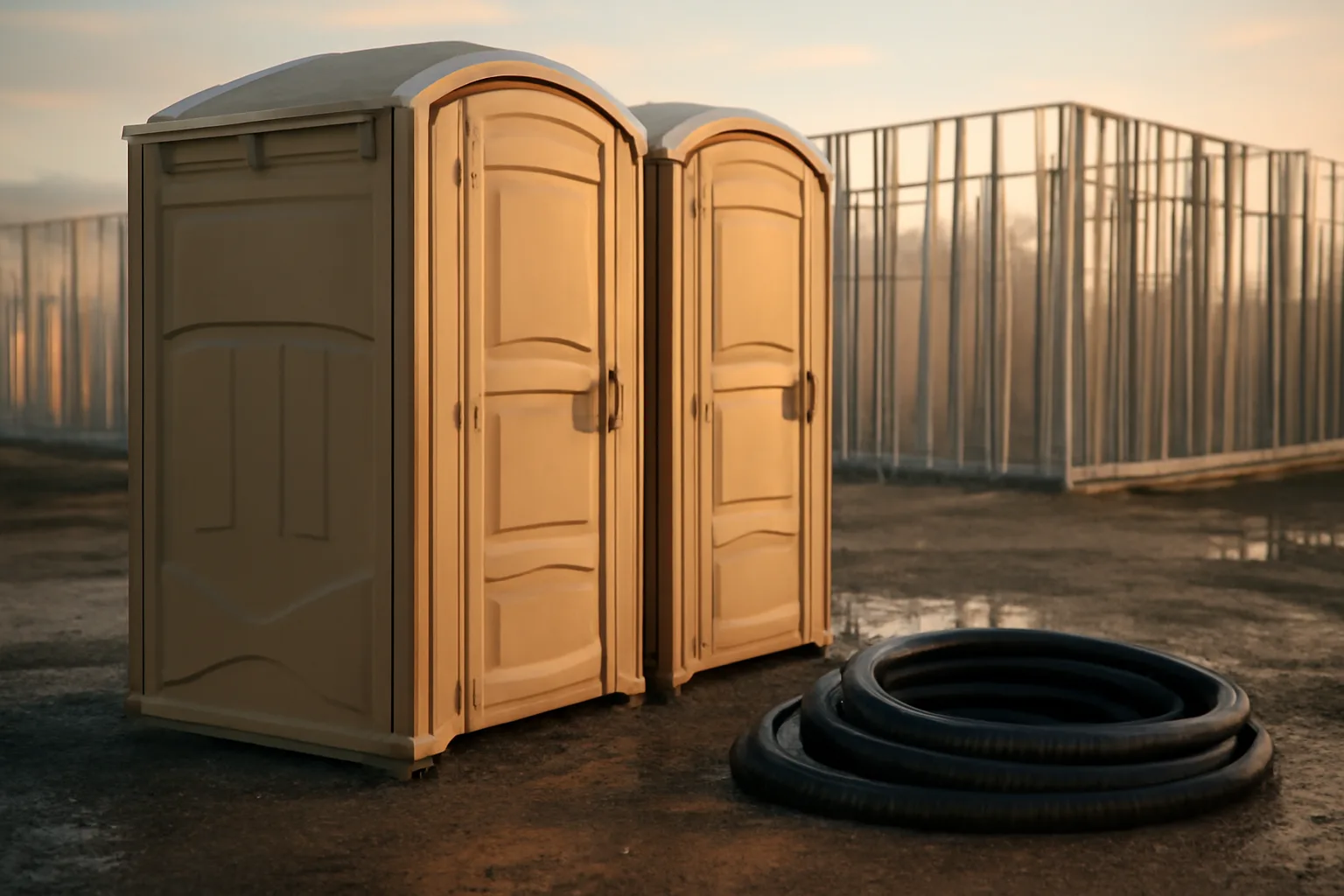
A standard unit is a plastic cabinet with a waste tank, a seat, a vent, usually a urinal trough, and a chemical charge. Customers pay for delivery, time on site, and how often you service the box. Construction wants a weekly or twice-weekly pump on a long drop. A Saturday festival wants a Friday set and a Sunday pull.
The tank mix becomes domestic septage once you pump it. EPA folds domestic septage into 40 CFR Part 503 when someone land-applies it. [3] Most new operators should not land-apply. They open an account at a municipal plant or another permitted receiving site and pay the tip.
Treat porta potty rental as density first and catalog second. A luxury trailer photographs well. It does not pay the note if you cannot dump on Tuesday and you have no weekly construction stops within a tight radius.
How many porta potties does OSHA require on a job site?
On a construction job site with no sanitary sewer, OSHA sets employee toilet counts using Table D-1 in 29 CFR 1926.51. Twenty or fewer employees need 1 facility. At 20 or more employees the rule is 1 toilet seat and 1 urinal per 40 workers. At 200 or more employees it is 1 toilet seat and 1 urinal per 50 workers. [1]
OSHA 29 CFR 1926.51 requires 1 toilet facility for a construction job site with 20 or fewer employees.
The construction standard also says, in the agency's own words, "Job sites, not provided with a sanitary sewer, shall be provided with one of the following: privies, chemical toilets, recirculating toilets or combustion toilets." [1] That chemical toilet line is why a plastic unit satisfies the federal construction duty when the site has no sewer.
General industry is a different rule. 29 CFR 1910.141 is the sanitation standard for many fixed workplaces, and it is written around water closets more than a unit in the mud. [2] Do not hand a factory client the construction table and hope.
California is tighter on construction. Title 8 section 1526 requires a minimum of one separate toilet facility for each 20 employees or fraction thereof of each sex. [12] Sell in California and the federal table is not the number you quote to a superintendent.
Events are messier. I have not found one national statute that sets a single festival ratio I trust. The local health permit and the producer set the count. Overshoot a little. Running out of toilets is how you lose the next booking.
| Workers on site (federal OSHA construction) | Minimum toilet seats | Urinals under Table D-1 |
|---|---|---|
| 20 or fewer | 1 | Not on the 20-or-less line |
| 40 | 1 | 1 per 40 workers |
| 80 | 2 | Yes |
| 120 | 3 | Yes |
| 200 | 4 | 1 per 50 workers at 200+ |
How do you start porta potty rental?
You start by proving you can legally dispose of waste. Then you file ordinary small-business paper. Then you get the hauler or portable sanitation credential your state or county board actually issues. Buy the truck and the units after those three doors open. That order keeps you from owning a yard of plastic you cannot pump.
SBA's start list is the same unglamorous sequence other trades use. Pick a structure, register the business, get tax IDs, then licenses. [10] The IRS EIN application is free. [8] File it after the state entity exists so the names match.
The part SBA cannot do for you is the dump. Call the wastewater plant or the county environmental desk and ask, by name, whether they take portable toilet waste and what truck paper they want. If they say no, you do not have a company yet. Do not put a deposit on a vacuum truck until that answer is yes and it is written.
Then read your board. There is no national porta potty rental license. California does not use Alabama's form. Florida runs portable restroom rules next to onsite sewage. A mountain West county may only want a pumper card. RestroomRoute keeps those board paths in separate state files, including porta potty rental board in california, porta potty rental board in florida, and porta potty rental board in arizona. Confirm every current fee with the board. I will not invent one.
Do not pick a launch Monday off a blog. Boards change forms. Plants change receiving hours. Get the disposal letter first.
What licenses do you need for porta potty rental?
You need a stack, not a single card. Federal law does not sell a porta potty rental permit. The sanitation piece is state or county. The rest is ordinary business and vehicle paper.
The stack I would actually assemble: an entity filing, an EIN, a city or county business tax certificate, zoning that allows trucks and stored units, the septage hauler or portable restroom registration your health or environmental board issues, vehicle registrations, and a written disposal account. Add a CDL and a tanker endorsement if the truck crosses those federal lines. [7] [8] [14]
Florida shows how specific a state can get. Rule 64E-6.0101 is the state's portable restroom and holding tank rule, sitting inside the onsite sewage chapter. [11] Other states only want a pumper permit and proof you can dump. Compare that with porta potty rental board in colorado or porta potty rental board in georgia before you copy a checklist from a national forum.
If a video says you just need an LLC and a logo, ignore it. An LLC does not authorize you to haul septage. The hauler credential and the plant account do.
Talk to a lawyer about entity choice. This site is not a law firm. Sole prop is cheaper on day one and mixes your house with the truck. That tradeoff is yours.
What ADA rules apply to portable toilets?
When single-user portable toilets are clustered, federal ADA scoping does not make every box an accessible toilet room. The U.S. Access Board text at 213.2 Exception 3 says, "Where multiple single user portable toilet or bathing units are clustered at a single location, no more than 5 percent of the toilet units and no more than 5 percent of the bathing units at each cluster shall be required to comply with 603." [5]
The 2010 ADA Standards, as published by the U.S. Access Board at 213.2 Exception 3, require no more than 5 percent of clustered single-user portable toilet units to comply with 603.
Read the exception as a cap on how many units in that cluster must meet the 603 accessible toilet room technical rules. You still put accessible units in the bank. A cluster of 20 is the easy math. Smaller clusters still need a usable accessible unit in practice, because 5 percent of 8 units is not zero on a public site. Confirm the current 2010 Standards and any state accessibility code that is tighter. [6]
Accessible cabinets cost more and need a firmer, wider pad. Budget them on public events and on any job that already ordered a row of standards. Skipping them on a city festival is not a clever save. It is how a complaint starts.
Private backyard jobs are a different conversation with the client. Public and commercial sites are not.
Where can you dump porta potty waste?
You dump at a facility allowed to take portable toilet waste, usually a wastewater treatment plant or a permitted septage receiver. You do not dump in a ditch, a storm drain, a car wash, or a field you "know."
EPA defines domestic septage in 40 CFR 503.9 as liquid or solid material removed from a septic tank, cesspool, portable toilet, Type III marine sanitation device, or similar treatment works that receives only domestic septage. [4] Part 503 then sets standards for final use or disposal of sewage sludge, and domestic septage sits inside that universe if you land-apply. [3] [15]
Stay off land application in year one. Get a receiving agreement. Keep the tickets with the truck number. Inspectors ask for those, not for your brand story.
Plants set their own hours, debris rules, and paperwork. Some want a bond or a generator ID. Confirm with that plant. I will not invent a tipping fee or a wait time.
If you cannot name the dump site before you buy units, stop. Disposal access is the business. The plastic boxes are inventory.
Do you need a CDL to haul portable toilets?
You need a CDL when the vehicle is a commercial motor vehicle under 49 CFR 383.5, including a single vehicle with a GVWR of 26,001 pounds or more. 49 CFR 383.23 requires the driver of that CMV to hold a CDL after passing the required tests. [7] [14]
A tank vehicle under the same definitions section is designed to transport liquid or gaseous materials in a tank or tanks with an individual rated capacity of more than 119 gallons and an aggregate rated capacity of 1,000 gallons or more. [7] Plenty of vacuum trucks clear both the weight line and the tank line. A light pickup moving empty cabinets may clear neither.
Weigh the real truck. Read the door sticker. Ask the state DMV CDL office. Do not take a payload guess from a group chat.
Hire a driver in CDL territory and you inherit drug testing and driver qualification files. That is overhead. I'd rather budget a licensed driver than pretend a 3-yard tank is a hobby trailer.
Towing a handful of empty units behind a one-ton is a different fact pattern than running a full service truck. Treat them as different questions.
What insurance and business paper come first?
Entity and EIN come before the first invoice. [8] [10] Form an LLC or a corporation in the state where the trucks live, then buy insurance the way a waste hauler buys it. A laptop consultant policy is the wrong product.
Shop commercial auto first. The vacuum truck is the claim that can end the year. Add general liability. Ask for a pollution or environmental impairment form because you haul sewage. Schedule the units so a stolen cabinet is not a cash gift to a job site. Add workers' comp if you have employees.
I will not quote a premium. Markets move. Your record and dump radius change the number. Bring the hauler permit, the disposal letter, and a unit count to a broker who already writes pumpers. If they only want to sell the same BOP they use for a coffee shop, leave.
A cheap policy that excludes pollution is a waste of money. So is forgetting the GC's additional insured wording and losing the site. Paper the certificate the way the contract asks, then keep a copy with the route sheet.
What equipment do you need in year one?
Year one equipment is a service truck you can legally dump with, standard units you can keep clean, a few accessible units, a handwash station or two if your market asks, water, deodorant, paper, PPE, and a yard that zoning allows.
Do not open with luxury restroom trailers. They are a different sale, a different damage deposit, and a different freeze problem. Earn a trailer after weekly construction stops are real.
How many cabinets? Nobody has a clean national dataset for the "right" opening fleet. The constraint is service capacity, not a motivational quote. If you can pump 25 units on a Saturday and still make the plant's last receiving hour, do not buy 80 boxes in month one. Idle plastic fades in the sun and ties up cash.
Used units are fine if doors latch and tanks are not cracked. New units feel better. Get current dealer quotes. Resin and freight move. I will not invent a sticker price.
Skip the wrap in month one if cash is tight. A readable magnetic and a clean interior get you the second week on a site. Chrome tanks do not.
How is construction porta potty rental different from events?
Construction is OSHA counts, weekly service, purchase orders, and a GC who wants to be an additional insured. Events are health department counts, short certificates, tight delivery windows, and a Monday pump that cannot slip. [1]
Construction pays the rent. Events spike cash and wreck your weekend. Take the boring site work first and add weekends when the route already covers the truck note.
Paper differs. A superintendent wants the unit close to the work and a ticket in the box. A parks desk wants accessible units, maybe a site map, maybe lighting. The ADA cluster rule shows up more on the event side. [5]
Write who pays for extra service after a heat wave or a double-shift pour. If you do not write it, you will donate a Saturday. Event contracts should also say who owns a tip-over and who calls if the crowd doubles.
Do not use the same service interval for both. A quiet site can wait a week. A beer garden on asphalt in July cannot.
What should you confirm with your state board?
Confirm the exact credential name, the form number, any exam or training, any truck inspection, insurance or bond minimums the board lists, and the current fee. Confirm whether portable toilet waste sits on the same permit as septic tank pumping. Then confirm the disposal site will accept your waste under that same permit.
Boards do not share a template. Use a state file as a map, then call. We keep operator-facing pages for porta potty rental board in alabama, Do You Need a License for Porta Potty Rental in Arkansas?, and Porta Potty Rental Board in Idaho and What You Actually Need. Pair those with the California, Florida, Arizona, Colorado, and Georgia pages already linked above if that is your market.
If the website and the clerk disagree, get the clerk's answer in writing. A screenshot of an old PDF is not a permit.
Never treat a processing time you saw on a forum as a promise. I will not invent a quota, a fee, or an approval clock. The board in front of you owns those facts.
What do first-year porta potty rental operations look like?
You live on a route board. Monday pump the long-term sites. Midweek catch overflows and new sets. Friday stage weekend units. Sunday or early Monday pull them. Tuesday becomes plant day if Monday was a holiday. Winter adds freeze-outs. Summer adds odor calls at 2 p.m.
Keep service tickets, disposal receipts, mileage, and incident notes. Needles in a tank, a tipped unit, a stolen door. Inspectors want the dump ticket tied to a truck, not a story.
Labor sneaks up on people. One person can run a tiny weekday route. Two people make an event weekend survivable. BLS tracks septic tank servicers and sewer pipe cleaners as SOC 47-4071 if you want a wage benchmark for hired help. Use the current Occupational Employment and Wage Statistics table. Do not use a blog number. [13]
Run fewer units on time before you run a yard of tired plastic. Density beats a giant service radius. A 90-minute deadhead to pump four boxes is how first years go broke while looking busy.
Want the paper checklist in one packet? The $199 one-time Portable Restroom Launch Kit is at /start. The state board articles stay free either way. This publication is independent. It is not a law firm and not a pumping company.
Frequently asked questions
What is porta potty rental?
Porta potty rental is delivering portable toilets, servicing them on a route, pumping the tanks, and hauling the waste to a legal disposal site. The Census Bureau classifies that work under NAICS 562991, which covers pumping septic tanks and cesspools and renting or servicing portable toilets. Customers pay for placement, time, and service frequency.
How do you start porta potty rental?
Lock a legal dump site first. Then form an entity, get a free IRS EIN, and apply for the septage hauler or portable sanitation credential your state or county board issues. Buy the truck and units after those doors open. Confirm current forms and fees with the board. No national license exists, and no publisher can promise an approval date.
Do you need a license to rent porta potties?
You need state or county sanitation credentials plus ordinary business and vehicle paper. There is no federal porta potty rental license. Many places issue a septage pumper or portable restroom registration. Florida even has a dedicated portable restroom rule at 64E-6.0101. Confirm the exact card with your board before you advertise.
How many porta potties does OSHA require?
For construction sites without a sanitary sewer, 29 CFR 1926.51 requires 1 facility for 20 or fewer employees, then 1 toilet seat and 1 urinal per 40 workers, and at 200 or more employees 1 seat and 1 urinal per 50 workers. California Title 8 section 1526 uses 1 toilet per 20 employees of each sex. Events follow local health permits, not that table.
Do portable toilets have to be ADA accessible?
When multiple single-user portable toilets are clustered, ADA 213.2 Exception 3 says no more than 5 percent of the toilet units in that cluster must comply with 603. You still include accessible units in the bank, especially on public and commercial sites. Check the 2010 Standards and any tighter state accessibility code before you bid a festival.
Do you need a CDL for a porta potty truck?
A CDL is required to drive a commercial motor vehicle, including many trucks with a GVWR of 26,001 pounds or more, under 49 CFR 383. A tank endorsement can apply if the tank setup meets the 119 gallon individual and 1,000 gallon aggregate tests in 383.5. Weigh the actual truck and ask your state DMV CDL office.
Where does porta potty waste go?
It goes to a wastewater plant or another permitted septage receiver that agrees to take portable toilet waste. EPA treats material pumped from a portable toilet as domestic septage in 40 CFR 503.9. Land application pulls you into Part 503. Most first-year operators should pay a plant instead. Never dump in a ditch, drain, or car wash.
Can you start porta potty rental with 10 units?
Yes, if you can legally dump, you can keep those 10 clean, and you have paying stops close enough to cover the truck. The limit is service capacity and disposal hours, not a magic fleet size. Buying far more cabinets than you can pump in a day ties up cash. Used, sound units are fine. Confirm permits before the first delivery.
How often should construction porta potties be serviced?
Weekly is the common construction interval, and busy or hot sites need more. OSHA tells you how many toilets to place, not the exact pump calendar. Write extra-service pricing into the contract so a double shift is not a free Saturday. Keep a ticket on every stop. Plants and GCs both ask for paper.
Is porta potty waste hazardous waste?
Portable toilet pump-out is domestic septage under EPA's 40 CFR 503.9 definition when the unit received that domestic waste stream. It is regulated. It is not something you handle like household trash. It is also not a reason to skip PPE. Follow your state hauler rules and the receiving plant's instructions. Do not improvise a dump site.
Is an LLC required to start porta potty rental?
No statute I trust makes an LLC the sanitation license. An entity is still a good idea so the truck and your house are not the same pile of assets, but that is a lawyer conversation. You still need the hauler or portable restroom credential, an EIN if you want one, local tax paper, and a legal place to dump.
What is a waste of money in the first year?
A restroom trailer before you have weekly construction density. A giant fleet you cannot pump before the plant closes. A cheap liability policy that excludes pollution. Vinyl wraps before repeat routes exist. Paying for a national "license kit" that is not your board's form. Spend first on disposal access, a legal truck, and units you can actually service.
Sources
- OSHA 29 CFR 1926.51 Sanitation: Construction job sites without a sanitary sewer must provide privies, chemical toilets, recirculating toilets, or combustion toilets, using Table D-1 counts (1 facility at 20 or fewer employees; 1 seat and 1 urinal per 40 workers; 1 seat and 1 urinal per 50 workers at 200 or more).
- OSHA 29 CFR 1910.141 Sanitation: General industry sanitation, including toilet facility requirements, is a separate standard from the construction chemical-toilet table.
- EPA 40 CFR Part 503 Sewage Sludge: 40 CFR Part 503 sets federal standards for final use or disposal of sewage sludge, including domestic septage pathways such as land application.
- EPA 40 CFR 503.9 Definitions: Domestic septage includes liquid or solid material removed from a portable toilet or similar system that receives only domestic septage.
- U.S. Access Board ADA Section 213: ADA 213.2 Exception 3 states that where multiple single user portable toilet units are clustered, no more than 5 percent of the toilet units at each cluster shall be required to comply with 603.
- U.S. DOJ 2010 ADA Standards for Accessible Design: The 2010 ADA Standards are the current federal design standards that include toilet room scoping and technical requirements used for accessible portable units.
- 49 CFR 383.5 Definitions (CDL and tank vehicle): A commercial motor vehicle includes vehicles with a GVWR of 26,001 pounds or more, and a tank vehicle includes tanks over 119 gallons individual and 1,000 gallons aggregate capacity.
- U.S. Census Bureau 2022 NAICS 562991: NAICS 562991 comprises establishments primarily engaged in pumping septic tanks and cesspools and/or renting and/or servicing portable toilets.
- U.S. Small Business Administration 10 steps to start your business: SBA's start sequence is to choose a structure, register the business, obtain tax IDs, and then obtain required licenses and permits.
- Florida Administrative Code 64E-6.0101: Florida maintains a dedicated onsite-sewage rule for portable restrooms and portable or stationary holding tanks.
- California Code of Regulations Title 8 section 1526: Cal/OSHA construction sanitation requires a minimum of one separate toilet facility for each 20 employees or fraction thereof of each sex.
- BLS OEWS SOC 47-4071 Septic tank servicers and sewer pipe cleaners: BLS publishes Occupational Employment and Wage Statistics for septic tank servicers and sewer pipe cleaners under SOC 47-4071, a wage benchmark occupation for hired pump-truck labor.
- 49 CFR 383.23 Commercial driver's license: No person may operate a commercial motor vehicle unless that person has passed the required tests and holds a commercial driver's license.
- EPA 40 CFR 503.1 Purpose and applicability: Part 503 establishes general requirements, pollutant limits, management practices, and operational standards for final use or disposal of sewage sludge from domestic sewage treatment.